
The Haunting of Hill House by Shirley Jackson: Book Review

Dr. Montague, a researcher into paranormal activity, has rented the fabled Hill House for the summer. The house has a reputation for being haunted. Very few people have managed to stay in it for more than a night. In order to sort of help the house do its worst, he invites people to stay with him who have had paranormal experiences. The only two who take him up on his offer are Theodora and Eleanor. Luke, the future heir to the house, also comes along. It does not take long for the house to show what it's made of. I think this might have been ruined for me by the narrator. The book is in third person, but is told from Eleanor's point of view. Why on earth did someone choose to have a man narrate? For the right book, he would be fine, and he did what he could with this. An older man with a deep voice is just not the right person to lead us down Eleanor's thoughts when she's so very--weak, maybe? No, uncertain is the better word. She's uncertain of her place in the world, in the house, in the group. She's also a dreamer who has a tenuous grasp on reality at best. The narrator definitely needed to be a young woman. Eleanor herself is something else. Her thoughts get to be a little disturbing. She's definitely an unreliable sort-of-narrator. I never really knew what was happening in the real world and what was only happening in her head. For that matter, I never knew what she was actually doing. Aside from that, I think I expected more of a horror angle. Sure, the house does get up to some crazy things, but nothing as bad as what I expected. I don't feel like…

The Odyssey by Gareth Hinds

Gareth Hinds undertakes the task of adapting The Odyssey, the tale of Odysseus's long journey home after the Trojan War, into graphic novel format. I wish this had been around when I was wading through The Odyssey in high school (and maybe college? I can't remember). I don't know what translation we read, but we needed a translation of it. I think most of us had only vague ideas about what was going on, and we probably only figured those out after the teacher spoon-fed them to us. The Odyssey is perfect for this format. It's a very visual story, with the sirens and Scylla and Charybdis, a journey to the underworld, the cyclops, and Circe's spell. I did like the illustrations, although they veered a little too close to the bulging muscles and gravity-defying breasts that most people think of when they hear the word, comic. Still, it's a manly tale, so they fit. I was a little surprised by the translation. I expected the writing to be very modern, but it's not. It's still very readable but formal at the same time. From page 4, Zeus speaking to Athena: "My child, what strange remarks you let escape your lips. Could I forget that wily hero Odysseus? You know I bear him no grudge--but Poseidon does, hates him for blinding his son Polyphemus the Cyclops. But come now, let us take up the matter of Odysseus's return. Poseidon must relent; he cannot thwart the will of all the other gods." I had forgotten much of what happens in the story, so it felt a lot like I was coming to this for the first time. I enjoyed it more in this format than I ever have before. This is a fabulous (re-)introduction to this timeless classic. Teachers, take note…

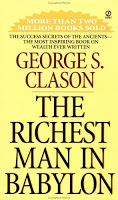
The Richest Man in Babylonby George S. Clason: Book Review

A co-worker insisted on lending me this book. It doesn't sound like my kind of thing, but I didn't know how to tell her I wasn't interested. We'll see how this goes... Written in a format that leaves me wondering whether to classify this as fiction or non-fiction, The Richest Man in Babylon uses the framework of established Babylonian men telling stories about how they gained their hard-won financial wisdom. The book is short and surprisingly readable for someone who doesn't understand much about Finance. I understand budgeting and saving, but that's as far as I go with that. The advice in the book seems sound to me, at least the parts that I understand. It boils down to: 1. Live on 70% of your income. 2. Save 10% of your income. 3. Use the remaining 20% to pay off your debts. Sound financial advice. Then it tries to get into investing. I just don't get it. The story in the book is about a man giving a shield-maker money for his business and the shield-maker pays him back with interest. I can't translate that into modern times. Oh, I know it's something about investing, but I'm so vague about how that works that I'm just left scratching my head, wondering where I can find an honest shield-maker. The format worked well for me. I was getting a little bit of a story along with my Financial Advice, so that made it easier. "A spoonful of sugar helps the medicine go down" kind of thing. I did get tired of all the "Thee" and "Thou." Maybe I'm wrong, but that's just King James English, right? I don't really think that's how ancient Babylonians talked. Just write "your" and be done with it. I guess it was supposed to give this…

Frankenstein by Mary Shelley: Book Review

Forget the big, green, shuffling, moaning monster with bolts in his neck that we've all come to associate with Frankenstein. He does not appear in these pages. I wonder what book those old horror movie writers read? It wasn't this one. Frankenstein's monster is big, but the only other physical descriptions I really remember are flowing black hair, watery yellow eyes, and uncanny speed, agility, and tolerance for cold. Oh, and he's more eloquent than I could ever hope to be. Seriously. As for Frankenstein himself--a more self-absorbed, self-indulgent, self-explicatory character I hope to never meet. He was terrible! This was his story: "Oh no! Something bad happened!" *clunk* He falls over in nervous delirium and is bed-ridden for months. He wakes. He moans and groans and just generally doesn't deal. Then one day: "Oh no! Something bad happened! But it wasn't my fault!" *clunk* He falls over in nervous delirium, bed-ridden for months, blah, blah, blah, blah. That really is Frankenstein's story in a nutshell. I do realize that this story was supposed to be more of a warning about our science getting ahead of our morals, pride coming before a fall and all that. On that level, it completely worked. As I read this, the word hubris kept coming to mind, and I haven't thought that word since studying the Greek myths for months on end my sophomore year of high school. That was more years ago than I honestly want to think about. Anyway, Shelley absolutely did what she meant to do and her work is always going to be relevant. But as a reader, I need a character that I can like. I don't think it necessarily has to be the main character, just give me someone, somewhere, to root for. There wasn't one here. Clerval…

We Have Always Lived in the Castle by Shirley Jackson: Book Review

"My name is Mary Katherine Blackwood. I am eighteen years old, and I live with my sister, Constance. I have often thought that with any luck at all I could have been born a werewolf, because the two middle fingers on both my hands are the same length, but I have had to be content with what I had. I dislike washing myself, and dogs, and noise. I like my sister Constance, and Richard Plantagenet, and Amanita phalloides, the death-cup mushroom. Everyone else in my family is dead." And so begins Merricat's story about life for the last surviving members of the Blackwood family. There has been some sort of tragedy in the past, but Mary Katherine doesn't want to talk about it. She does want to talk about how much the villagers hate her family, how much she hates them, and how she wishes she could live on the moon. Unsettling. That is by far the best word to describe this book. Odds are that you didn't make it through high school without reading Shirley Jackson's short story, "The Lottery." It would be a tossup between that and "The Yellow Wallpaper" by Charlotte Perkins Gilman for my choice as most disturbing short story ever. Jackson somehow kept that same tone alive throughout a novel. Short stories are generally creepier for me than novels are. Authors end up explaining too much in a novel and I'm able to put them out of my head. But all those unresolved questions in short stories cause them to stay with me in a way that very few novels do. But Jackson pulled that off here. Wow. So much of the eeriness comes from Mary Katherine, or Merricat, herself. She's eighteen, but it's almost like her mind stopped progressing at twelve, which is when…

East of Eden by John Steinbeck: Book Review

Synopsis from GoodReads: In his journal, John Steinbeck called East of Eden "the first book," and indeed it has the primordial power and simplicity of myth. Set in the rich farmland of California's Salinas Valley, this sprawling and often brutal novel follows the intertwined destinies of two families--the Trasks and the Hamiltons--whose generations helplessly reenact the fall of Adam and Eve and the poisonous rivalry of Cain and Abel. Adam Trask came to California from the East to farm and raise his family on the new, rich land. But the birth of his twins, Cal and Aron, brings his wife to the brink of madness, and Adam is left alone to raise his boys to manhood. One boy thrives, nurtured by the love of all those around him; the other grows up in loneliness, enveloped by a mysterious darkness. First published in 1952, East of Eden is the work in which Steinbeck created his most mesmerizing characters and explored his most enduring themes: the mystery of identity, the inexplicability of love, and the murderous consequences of love's absence. A masterpiece of Steinbeck's later years, East of Eden is a powerful and vastly ambitious novel that is at once a family saga and a modern retelling of the Book of Genesis. I am surprised by how much I liked this book. I had to read Of Mice and Men and The Grapes of Wrath for school, and I pretty much hated them both. Of course, I hated almost everything I had to read for school, so I don't know if that says more about Steinbeck or about me. Either way, I was left with bad memories of Steinbeck. I have several friends on GoodReads comment on how much they love this book, so when I found this edition with this cool…

Their Eyes Were Watching God by Zora Neale Hurston: Book Review

Janie Crawford is only 16 years old when her grandmother decides to marry her off to a man who is well-respected in the community. Nanny has had to work hard all her life and she wants Janie to have an easier life. She marries her off as soon as she notices boys noticing Janie. It comes from a place of love, but Janie wants to live life, not just settle for comfort. So she sets out to live the kind of life she wants to live. You just have to admire Janie. My gosh, does she just take a big bite out of life and chew it with gusto! She does not have an easy time of it by any means. But she weathers the hard times and she wrings every drop of sweetness out of the good times. She learns early on that she shouldn't be too concerned about what others think of her choices. She's the one who has to live with her decisions, so she's the only person she needs to please. And besides, you can't make everybody happy, so why even try? I already knew a little about the town of Eatonville, Florida,  the first incorporated all-black town in the US, from reading Zora and Me by Victoria Bond and T.R. Simon. That was getting a little out of order, but I did like reading this and seeing where some of Bond and Simon's ideas about the young Zora came from. The town and the alligator stories were especially interesting to me. I did have a little bit of a hard time with the dialect that the book is written in. I think for about the first half of the book, I was laboriously sounding out each word and translating it in my head. I finally…

The Color Purple by Alice Walker: Book Review

Celie is only a young teen when her stepfather marries her off to their widowed acquaintance, Albert. Celie is little more than a slave to the family. Albert has several spoiled children who terrorize her and he regularly beats her himself. Celie just puts her head down, writes letters to God, and tries to go unnoticed. As time goes by, Celie loses contact with her beloved sister, Nettie. She starts writing letters to Nettie as well, but she never hears back. Then Albert moves his ailing lover, blues singer Shug Avery, into the house and expects Celie to take care of her. Far from feeling jealous of Shug, Celie is relieved that someone is there to deflect Albert's attention from her. The women become friends and Celie realizes how much more there is to life than what she's getting out of it. I read this in order to have a review ready for Banned Books Week. I'm not sure what on earth possessed me to buy it at a library book sale. I've always been a little afraid of it, ever since hearing my grandmother talk about the movie years ago: "Oprah wasn't going to let that man beat on her." Wife abuse. Not exactly my cup of tea. I was surprised to find myself loving the book. I was taken aback in the very first pages, I'll admit. Rape and beatings and killing babies, and all of this happening to a 14-year-old girl. I didn't know if I was going to be able to finish it. I'm so glad I stuck with it. You see, Celie is not obviously a strong person. She is a survivor, but she doesn't really thrive. She just gets by. Watching her come into her own and become a woman to be reckoned with…

Anna Karenina by Leo Tolstoy: Book Review

This is primarily the story of Anna Karenina's troubled affair with Alexey Vronsky. It's also the story of Konstantin Levin's search for love and truth in society. While reading this book, I kept wishing that I could just read a "good parts version" as William Goldman called The Princess Bride. I kept getting bogged down in Tolstoy's reflections, mostly through Levin's eyes, of how decadent, silly, redundant, and complicated life in the upper class of 19th-century Russian society was. There would be pages and pages of a tangent that could have been an essay called "What's Wrong With Agriculture in Russia." I didn't care. There were also pages and pages of Levin watching an election and having no idea what was going on. If he didn't get it, there's no way that this 21st-century American woman is going to. Those parts just seemed to drag on and on and on. But the story itself was beautifully written and really made me think. I'm all for women's rights, but I would catch myself thinking, "What a selfish, ungrateful woman!" And then I would think, "Well, if it weren't for women like Anna pushing the limits of acceptable behavior, you wouldn't enjoy the freedoms you do today." And then I'd go right back to thinking, "I can't stand her! She wants everything her way!" I'm not really exaggerating. I really had this internal dialog going on throughout almost every scene that featured Anna. I think part of the problem for me was that her husband was a good man, she just didn't love him. So I was torn between how Anna was hurting him and her quest for love. I was worried about reading this, not necessarily because of the size, but because I wasn't sure how difficult it would be to…

Bridge to Terabithia by Katherine Paterson: Book Review

Jesse Aarons is the class misfit. Something of a dreamer, and a talented artist, he just doesn't fit in with his practical, competitive classmates. But Leslie Burke moves next door at the beginning of their fifth-grade year, and the two eventually become best friends. Leslie shows him that a different life is possible. I'll just say it--this book irritated me to no end. It was crawling with Southern stereotypes. For a book that's trying to show that there's a place for everyone in the world, I just really found that unacceptable. It seemed like most of the characters went by two names: May Belle, Joyce Ann, Wanda Kay. I'm sure there were more. And then there was the fact that everyone, except for Jesse, Leslie, and her family, couldn't speak without throwing a double negative in there. It happens. It's not as bad as this book makes it sound. And then there was the way that all the poor kids were stupid, narrow-minded, and ignorant, and their parents beat them when they weren't in jail. Give me a break. Had I read this when I was younger, I would probably have overlooked all of that and just focused on the story of the beautiful friendship between Jesse and Leslie and how she showed him that there is a bigger world out there and how we should always show each other kindness. That's a great message. But I didn't read it when I was younger and right now I just don't care. Reviewed May 25, 2009 Read an excerpt. Find author Katerine Paterson on her website. Buy Bridge to Terabithia at Malaprop’s | Better World Books Friday Flashback Reviews are a weekly feature here on The Introverted Reader. These are old reviews I wrote on GoodReads. Thanks to Angieville and her…