The Witches by Roald Dahl: Book Review

Our young British protagonist and his Norwegian grandmother know something that we don't: Witches are real and they live among us. They look like sweet neighbor ladies but they're keeping a lot of secrets. Chief among them? They want to wipe out the children of the world. When Grandmamma and Grandson (do we ever learn his name?) go on vacation to the coast of England, they stumble on the annual witches' meeting, led by The Grand High Witch herself. The witches have a plan to eliminate all the children of England at once! That won't happen if Grandmamma and Grandson have anything to say about it. Confession: I remember starting to watch this movie when I was little and spending the night at my grandmother's house but it scared me to death. We had to turn it off. I told my husband this and he asked, "How old were you?" I looked up the release date of The Witches. It came out when I was 12. 12! And I was probably 13 by the time it came out on video or on tv or however I happened to catch it! What can I say? I was sheltered. And Anjelica Huston intimidates me to this day. I can just imagine facing her as a tween, on a screen or not. *shudder* Now that I'm firmly in my 30s, I'm brave enough to read the source. It was so much fun! It was (obviously) scary and suspenseful enough to satisfy most children but it had an element of silliness and impossibility that captures the imagination. There's really no such thing as a bald witch with claws, no toes, blue spit, and a removable face. But what if there were? *shiver* I enjoyed Grandson's bravery and Grandmamma's willingness to let him take risks…

In the Night Kitchen by Maurice Sendak: Book Review

Young Mickey hears a noise deep in the night and finds himself falling into the Night Kitchen, where he has to help the cooks get the milk into the batter. What a fun little book! I never read much Sendak when I was little for some reason, so this was completely new to me. The illustrations were tons of fun, of course. The kitchen is set against a "skyline" of boxes of cake mix, tall salt shakers, and an elevated bread train. They're perfectly whimsical for this book. I imagine children would love the story of little Mickey saving the day. I know I did! How much fun is it to imagine that only you can accomplish something important while the world, including your parents, is sleeping? It should also be a great book to read aloud. It's short and to the point and rhymes just enough to roll off the tongue. I highly recommend this one to parents with young children as a fun little bedtime story. Apparently some parents and even librarians are/were upset that a few pictures depict Mickey nude. I was a little taken aback myself when I saw it and knew that had to be the reason the book shows up on banned/challenged lists. After thinking about it, I decided that most kids are probably going to giggle, think the book is even more fun, and move on. It's perfectly innocent. Heck, if I want to get all analytical, we can talk about Mickey shedding his normal life of pj's and bedtime for the more illicit, and therefore more enjoyable, world of being up in the night and saving the day, all things kids probably aren't supposed to do. It represents freedom to them, even if they can't articulate that. View an excerpt. Buy In…

Labyrinths by Jorge Luis Borges: Book Review

Um, I think I missed something. This book's average rating on GoodReads is 4.47 as I write this and I'm rating it 2 stars. Where did I go wrong? It's been a while since I finished so I won't be able to get too specific. First of all, I didn't particularly care for the writing style. Something about his writing reminded me of H. P. Lovecraft, who I also don't fully appreciate, so that was a negative. I found it to be a little...overwrought at times. I don't think it was the translation because there were many translators throughout the collection and the style was pretty consistent. And then I think Borges is just way too smart for me. I could see that there was all this philosophical stuff going on in the subtext of his writing, but I didn't care enough to stop and think about it and try to figure out what he was really saying. I was just trying to wrap my head around a world that was created in imagination and then starts to slowly creep into the real world. Or trying to determine which of two characters was the dreamer and which was the dreamed. Or were they the same? And why did this head injury leave this character with a Phenomenon-like memory and intelligence? And what the heck is the point of trying to see if you can perfectly re-write Don Quixote by accident? And if I lived in a never-ending library, would I seriously spend all my time searching for the one book with the answers to Life, the Universe, and Everything (Thanks, Douglas Adams) or would I just sit down with the books I had and leave others to the searching? I think my reaction to this book answers that last question.…

The Woman in White by Wilkie Collins: Book Review

Walter Hartright finds a woman, all in white, wandering down the road to London in the middle of the night. As they talk and walk, she mentions that her happiest times were spent at Limmeridge House as a child. By coincidence, Walter is leaving to become a drawing teacher at this house the very next day. In talking this over, it's revealed that the woman in white has been badly mistreated and there are many more secrets surrounding her. I find it hard to judge a book by how it would have been received in its time. I can only judge by my modern-day standards. That being said, I was disappointed in this book. I really expected more. I found the mystery to be mostly predictable. There were a few twists and turns that honestly surprised me, but I saw the big picture from pretty far out. I know this book was supposed to be one of the first mystery novels and should receive a lot of respect for that. But my problem is that I found a lot of the elements to have become cliches. I realize that this isn't being fair to this particular book, but there you go. It hasn't weathered that well for me, personally. The way that Collins wrote about women drove me crazy. He has one very strong, very intelligent female character who is always spouting off about how "we women can't be quiet" and stuff like that. Having a woman say it doesn't make it okay. I know this might have been pretty standard fare for the time period, but I didn't care for it. It doesn't help me feel any better when we realize that the smart woman is ugly and mostly overlooked as a romantic prospect, while her boring, weak but…

The Sun Also Rises by Ernest Hemingway: Book Review

A group of friends travel to Pamplona, Spain for the annual running of the bulls and subsequent bullfights and fiesta. I didn't like it. Not one bit. We read this for my book club because one of our members remembered loving it when she read it in an English class and had been wanting to re-read it. Even she said it was not at all what she remembered and it must have been made better by an awesome English teacher. Let's hear it for awesome English teachers! Left to struggle through on my own devices, however, I found nothing redeeming in any of these characters. Which was probably the point, but still. I like to read about characters that I actually like. The best one was the narrator, so that was a plus, but he couldn't keep his friends in line and I don't think he wanted to. They were all so very cynical and had seen everything and done everything that they got a little boring. I told one of my friends who hadn't quite finished by the time our meeting rolled around, "Let me save you some time. They go out, get drunk, Brett sleeps with someone who is not her fiance, the Jew (as he was mostly known) got mad that she wasn't sleeping with him and hit somebody, they all drank some more, and started over the next day." And that's what I took away from this book. Life is short and boring, you drink and argue, then you die. I did like Hemingway's style. He's very short and to the point and without seeming to waste a lot of time on description, he manages to put you firmly in a scene. I would occasionally get confused as to who was speaking because he didn't like…

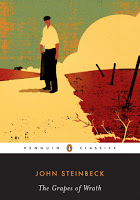
The Grapes of Wrath by John Steinbeck: Book Review

Tom Joad, just released from prison, heads back to his parents' farm only to find that they have been evicted from their land and are on their way to California in search of a fresh start. Thousands of families are in a similar situation and there are many ruthless people along the way who take advantage of them, mistreat them, and make their lives harder than they have to be. Is there another version of this book floating around out there somewhere? Because this is not the book I remember reading in high school. Yes, I'm joking. Sort of. I deeply disliked this when I had to read it for class. All I could remember was how depressing it was and the very, very last scene. It made an impression on my 16-year-old self. Now firmly in my 30s, I don't know if 16-year-old me was an idiot or if current me is just old and jaded, because I just about loved this. I'd give it 4.5 stars if I could. It's still dark and depressing, there's just no way around that. Everything that can go wrong for the Joads, does. From before they even hit the road, and I'm sure continuing on well after the last page is turned, they just can't catch a break. It was infuriating, even more so because I knew that this was firmly based on the reality of the Dust Bowl and the Depression. But this time around, I saw some hope. The Joads are not beaten. They have taken a beating and they are down, but I don't think they're out. They're still out there struggling along, doing the best they can, for themselves and others. Do you see that? And others. They have practically nothing, but they still give what they have…

Doctor Zhivago by Boris Pasternak: Book Review

Set in the early days of the USSR, Doctor Zhivago is the story of the doctor and the sweeping changes he bears witness to. Oh, I had a hard time with this one. It was sheer stubbornness that got me through. I didn't particularly like Doctor Zhivago, I thought Lara was crazy, and I couldn't keep up with the politics. I kept thinking that I should look up the Russian Revolution (or whatever it's called) and try to make some sense out of what was going on, but I didn't care enough to even do that. There were philosophical discussions planted smack in the middle of conversations. Of course I didn't believe anyone has ever actually talked that way. I couldn't follow the philosophy and then I lost the thread of the conversation by the time the characters got back to talking about something I was interested in. The doctor was the epitome of "not to decide is a decision." He just went with whatever situation he found himself in. He had some ideals when he was young that he fought for, but then he became jaded and seemed not to really believe in anything. But I could be wrong about that. As his family life changed, he never fought for anyone. He just took the easiest path before him. Lara was at least passionate but I felt she was inconsistent. Who did she really want to be with? I'm not entirely sure. She said one thing but did another. What I did take away from the book is how confusing it must have been to live through a time like this. I have a feeling the confusion about who was fighting whom and why was done deliberately. I can't imagine living through a war and never being sure who…

The Great Gatsby by F. Scott Fitzgerald: Book Review

Nick Carraway moves from the Midwest to Long Island to try to make a living after World War I. He is curious about his neighbor and the extravagant parties he throws every weekend. Eventually the two meet and become something like friends. The neighbor, Jay Gatsby, is shrouded in myth and legend and no one seems to know where he came from, how he made his money, or anything at all about him for that matter. Gatsby has a very specific reason for living where and how he does and his personal struggle pulls several others into his wake. Like many others, I decided to re-read this before the movie comes out. I disliked it in school but I've changed my mind about almost all the other classics I've bothered to re-read, so I thought I might change my mind about this one too. Not really. If you follow my reviews at all, you know that I am a very character-driven reader. Give me an awesome character and I'm happy. But there is not one likeable character in this novel. I think I kind of liked Nick in high school but now I don't even like him. He's by far the best of the bunch but that's not saying much. Gatsby himself is kind of pitiable. He's worked hard, being pushed constantly by an overweening ambition. He seems to have been born with a desire for more than he has but circumstances cause him to push himself even harder. He surrounds himself with people who don't bother to know him and seems to think that this is what gives a man a full life. Or rather, he thinks its a step on the way to fulfilling his deepest desire. He just made me feel tired and sad. He could have…

A Study in Scarlet by Arthur Conan Doyle: Book Review

Synopsis from GoodReads: In 1887, a young Arthur Conan Doyle published A Study in Scarlet, creating an international icon in the quick-witted sleuth Sherlock Holmes. In this very first Holmes mystery, the detective introduces himself to Dr. John H. Watson with the puzzling line “You have been in Afghanistan, I perceive,” and so begins Watson’s, and the world’s, fascination with this enigmatic character. In A Study in Scarlet, Doyle presents two equally perplexing mysteries for Holmes to solve: one a murder that takes place in the shadowy outskirts of London, in a locked room where the haunting word Rache is written upon the wall, the other a kidnapping set in the American West. Picking up the “scarlet thread of murder running through the colourless skein of life,” Holmes demonstrates his uncanny knack for finding the truth, tapping into powers of deduction that still captivate readers today. I read a lot of Sherlock Holmes way back in high school one summer. When I ran out of library books, I occasionally delved into my parents' shelves and that's how I was first introduced to Mr. Holmes. I have a collection on my nook now and I decided to re-read this first--novella, I'll call it--for old times' sake. I really didn't like it. I enjoyed the setup with Sherlock Holmes and Mr. Watson and their meeting and all that. But the actual mystery? Improbable is not even the word for it. It just defied belief. Why wouldn't a British detective know all about the American West? Please. The whole murder and everything is just overly melodramatic. And then there was the way that the Mormons were portrayed. Unflattering to say the least. I am not Mormon and know shamefully little about the faith, but my goodness--I was offended on their behalf! I'm sure…

I Capture the Castle by Dodie Smith: Book Review

Cassandra Mortmain lives in a castle. Don't let that fool you--the castle is crumbling around her family's ears. Her father had the (mis)fortune to publish an incredible book early in his career and he hasn't been able to write another word since. In other words, the family is practically destitute. But then the owner of the castle dies and his American relatives inherit the property. Two young, handsome, and available relatives. Will one of them fall in love with Cassandra's older sister Rose and turn the family's fortunes around? I think that if I had found this book when I was about 15 I would have fallen in love with it. At 30, I really, really liked it. The story is told through Cassandra's journal, and she is brutally honest and funny. She's one of those characters that you wish you knew in real life. Really, I felt something for every character, whether I was amused by Cassandra's spacey stepmother, Topaz, or frustrated by Mr. Mortmain, they all got a response out of me. The story was enjoyable--funny, sad, reflective, and everything in between--and kept me guessing all the way through. I had no idea how everything was going to turn out. Primarily though, this is a story about Cassandra's coming of age. We watch her go from an innocent child swimming in the castle moat, to a young woman learning about herself and what she's looking for in love. Those parts were timeless and perfect. There can't be many women out there who don't relate to what Cassandra goes through in the course of the story. For that reason, I would recommend this to anyone who wants to relive a little bit of those years, as well as those who are going through that stage of life right now.…