The Bells by Richard Harvell: Book Review

Moses Froben, an opera singer of world-renown, raised a son who could not possibly have been his own. When his son asked how they had come to be together, Moses would studiously avoid the question. On Moses's death, however, his son found a memoir that told of Moses's humble beginnings and how father and son found each other. The side of me that loves dark, convoluted, Gothic stories absolutely loved this book! A mother widely believed to be mad, an evil father, life with monks, and love against all odds just add up to the perfect read when I am in the right mood. And I was in the right mood for this one. Gothic doesn't feel like exactly the right word to describe this book, but melodramatic has a negative connotation, at least to me, so I'm going to stick with Gothic. Moses is a sensitive soul, and I found myself wanting to protect him in his childhood years. As he grew up and started to go after what he wanted, I was firmly on his side, cheering him on through everything. I won't get into the supporting characters too much for fear of giving something away, but I even loved and loathed them as I was supposed to. I will give you this quote about a bookish monk*: "And sure enough, the next Thursday, when Nicolai had fetched me from rehearsal and scrubbed my face and combed my hair, there stood Remus, dressed in hat and cloak and carrying a satchel full of books as though we would be traveling for many days, as if running out of books were tantamount to running out of air." Who among us can't relate to that? And they were only going to be away for a couple of hours! Moses' descriptions…

The Christmas Box by Richard Paul Evans: Book Review

The Christmas Box is about a young couple and their young daughter who move in with an elderly widow to help her out with light chores in exchange for rooms. Mary, the widow, becomes an adopted grandmother to them all and feels compelled to pass on wisdom she has gained with her years. This was a nice, easy read (I literally read it in about an hour). The lightness of the story, though, masks the underlying lesson about the first gift of Christmas and the preciousness of time. I would recommend this to anyone, but especially busy parents who are maybe starting to lose sight of what really matters to their children. Reviewed December 6, 2007

Everything is Going to be Great by Rachel Shukert: Book Review

After college, Rachel Shukert ended up working for free for a well-known experimental theater director. The play took a brief tour of Europe, and Rachel was thrilled when she found out that her passport had not been stamped. That meant she could stay in Europe as long as she wanted without a visa, since no one officially knew she was there. Setting out to "find herself," she ends up living with two of her gay best friends in Amsterdam, jobless, but more than willing to try out the local booze and dating scene. I'm not the right reader for Everything is Going to be Great: An Underfunded and Overexposed European Grand Tour. Call me a prude if you want, but I somehow (thankfully) avoided the stage of life that Rachel Shukert describes in her memoir. I don't understand the appeal of drinking until you end up in the hospital, or waking up with a man you met for the first time the night before. So when I ran into both things within the first few pages of this memoir, I knew this wasn't going to be a book that I connected with. If you did go through this stage, perhaps you'll enjoy this memoir more than I did. It is funny, but, like I said, I just didn't really connect with what Rachel was going through inflicting on herself. The book is well-written, and I did end up cheering for Rachel in the end, but the lifestyle described in the pages is a turn-off for me. Thanks to Harper Perennial for sending me a copy for review.

Spilling the Beans on the Cat’s Pajamas by Judy Parkinson: Book Review

Have you ever wondered exactly where some of our more common phrases come from? Judy Parkinson sets out to give a brief definition and history of some colorful, common English sayings. I found this book interesting and I learned a lot. For example, "Put a sock in it!" comes from the days of the old gramophones. They didn't have volume controls, so to turn the record player down, owners would put a sock inside the bell the sound emerged from. While I did enjoy learning the meaning behind some of these sayings, I have to say that the definitions were a bit dry. Take this definition of "shoot the moon": "This is an expression meaning to leave without paying one's bills or rent, or to remove swiftly one's household goods under cover of night to avoid their seizure by a landlord or creditor." This seemed like a good place to have a little fun or lighten the tone, but instead it felt more like a scholarly work. This is a short little book at 169 pages, so I wasn't expecting the scholarly tone. This is an interesting look at some of the origins of our language, and I recommend it for those curious about such things. Christmas is coming up, and I think this would make a good stocking stuffer if you have any lovers of language in your life. Thanks to FSB Media for sending me a copy for review.

The Ice Soldier by Paul Watkins: Book Review

William Bromley is a World War II veteran living in 1950's London. In the war, he led a mountaineering expedition that ended disastrously. He has never moved past this and started living again. He's just existing--teaching school, admiring the secretary from a distance, spending Friday evenings with his one friend, and visiting his father on school breaks. There's nothing exciting in his life and that's the way he likes it. Notably, he has also completely given up mountain climbing. Then something changes and he is left wondering if his life is really enough and does he have the courage to start truly living his life again? I enjoyed this. The story itself was very well-written and easy to read. The pacing was good and the way that things were slowly explained really worked. Probably the best part was that within this very straightforward story, the author manages to explore big themes like man vs. nature, the nature of friendship among men, and what war can still do to those lucky enough to survive. In other words, it works on many levels. If you want a simple adventure story, that's in here. If you want something to chew over and think about for a while, that's in here too. Reviewed June 21, 2008

Once Upon a Marigold by Jean Ferris: Book Review

My seven-year-old cousin and fellow lover-of-all-things-fairy, Natalie, convinced me to read this by reciting the cover blurb to me: "Part comedy, part love story, part everything-but-the-kitchen-sink." What fairy tale fan could resist that? Not this one! I loved that the defining characteristics of the characters weren't their beauty or lack thereof. Chris is intelligent, kind, and loyal. He's also an inventor. He's the first in the kingdom to use p-mail (pigeon mail). Princess Marigold is a reader, also intelligent and kind, and very concerned with making sure that she becomes a good strong ruler of her kingdom. She even asks commoners' opinions on the qualities that a good ruler should have! Even the minor characters are generally defined by their personalities, good or bad. Looks really didn't come into play at all. I found that a little refreshing. The story was a little predictable. We first meet Chris when he's a six-year-old runaway living in the woods. As he grows older, he starts to notice Princess Marigold, who he can watch as she reads on her terrace in the castle. He wants to be her friend, and he wants to know why she frequently looks unhappy. You can probably guess the general outline of the story, beginning to end, just from that. But there were still several surprises along the way that kept the story fresh. Ed the troll might have been my favorite character. Oh, I really liked Chris and Marigold, but Ed made me laugh. He loves to use common sayings, but he can never get them right. Here's one: "But now that you have your act on the ball, you can do better...All you have to do is keep your shoulder to the grindstone and your nose to the wheel." Too funny! And he's working hard to…

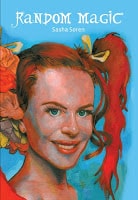
Random Magic by Sasha Soren: Book Review

Professor Random has sneezed Alice right out of Wonderland. He sends young Henry Witherspoon into the book to find her and put her in her place before the world as we know it comes to an end. But Henry accidentally gets sent into the wrong book. Luckily, he meets the unflappable doodle witch, Winnie Flapjack, who takes him under her wing and helps him find his missing Alice. This book is for those people who actually believe that it's about the journey and not the destination. Me? I just want to get where I'm going. The book was fun, and I enjoyed seeing where Winnie and Henry were going to end up next and how they were going to get out of their current mess. The overall plot of finding Alice isn't a very big deal in the book though. It's more of an excuse to throw everything together. I enjoy books more if everything flows together better. Winnie's solutions to problems were ingenious. Change live to dead? She can do that, no sweat. Defeat a crazy queen in chess? Sure. Take on a boat full of pirates? All in a day's work to Winnie. Henry was a different matter. He was a loyal little thing with a big heart, but he was a little slow. He never learned to just do what Winnie said; he was always questioning her. He always came out the worse for it. The pacing was a little off for my taste. Some of the vignettes dragged on too long for me. Oh! I almost forgot! The prologue is confusing. As far as I can tell, it has very little to do with the rest of the book. So just skip it. My sister grabbed this and read it while she was house-sitting for me,…

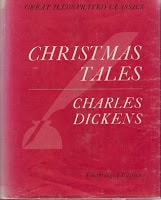
Christmas Tales by Charles Dickens: Book Review

I read this for A Christmas Carol but decided to read the rest and see what else Dickens had to say about Christmas. There were a few other little gems, although none were as good as A Christmas Carol, but there were some that I didn't like at all. A Christmas Carol was a 4 star book for me. It was entertaining, Dickens made his point pretty quickly, and it was actually kind of funny. That surprised me. I loved this part: "Old Marley was as dead as a door-nail. Mind! I don't mean to say that I know, of my own knowledge, what there is particularly dead about a door-nail. I might have been inclined, myself, to regard a coffin-nail as the deadest piece of inronmongery in the trade. But the wisdom of our ancestors is in the simile; and my unhallowed hands shall not disturb it, or the Country's done for. You will therefore permit me to repeat, emphatically, that Marley was as dead as a door-nail." I'm glad I read this, but at the same time, I can't help but feel that if you've seen one of the many, many movies, you know what the book is about. There is very little in the book that doesn't make it into the movies. Read it if you're curious, but don't feel you're missing out on anything if you don't. "The Chimes"--2 stars--This was similar to A Christmas Carol, but this time a poor man is shown how much worse the world could be. There aren't any little flashes of humor, the book got very preachy, it was too melodramatic, and I was left wondering why Trotty, the main character, is going through all this when he's surrounded by rich jerks who really need to be taught a lesson.…

Annexed by Sharon Dogar: Book Review

In Annexed, author Sharon Dogar imagines what life in the Annex with Anne Frank must have been like for young Peter. We know all about Anne's thoughts and feelings, but surely Peter needs a chance to tell his side of things too. The novel begins as Peter is dying and looking back on his life, desperate to tell someone his story. The first part of this book was really about 4 stars for me. It wasn't anything hugely different from what I would have imagined, but it was nice to see a different perspective on the other housemates. Anne frequently used her diary as a place to vent, so we tended to see the worst parts of everyone. In this book, Mrs. van Pels is shown as a caring mother who frequently says inappropriate things to help draw attention away from shy Peter. She steals the Franks' sheets to help him out too. His dad makes his awful jokes as a way to try to break tension. Mr. Frank is a wise, understanding mentor. Margot is inscrutable, but Mrs. Frank and Mr. Pfeffer are still pretty difficult to live with. Anne herself isn't always easy to live with, with her high ideals and mercurial personality, but she always makes life interesting, even within the confines of the Annex. The second part left me feeling shattered. Anne Frank's diary is a difficult read, because you do know how the story ends. But the diary just stops and, in the edition I read anyway, there was a very dry summation of what happened to the inhabitants of the Annex after their capture. If you've read any Holocaust literature at all, you can fill in the blanks, but it's easy just to not think about it and feel sad that Anne didn't live…

The Classics by Caroline Taggart: Book Review

Do you ever find yourself reading along, and when you come to a reference to ancient Greece or Rome, you start scratching your head? With sort of a, "I think I heard something about that somewhere, but I don't remember much about it" kind of thought? The Classics:  All You Need to Know, from Zeus's Throne to the Fall of Rome is the book for you. Caroline Taggart has put together a short (169 pages) primer/refresher for all that ancient stuff that you used to know but that has fallen by the wayside. Or maybe you never learned it in the first place. For such a short book, Taggart has packed a surprising amount of information into it. Topics covered include language, mythology, philosophy, history, the arts, the sciences, and a few more things. You won't read the book and be an expert by any means, but you will certainly have a decent base of knowledge to work from. The book might sound boring, but Taggart's style is actually pretty fun. "Atlas was inhospitable to Perseus (see page 47), who used the head of Medusa to turn him into a mountain range in North Africa, which takes almost as much talent as cutting someone's head off while looking at their reflection in a shield, and makes me think that Perseus could have taught David Copperfield a thing or two." She also occasionally mentions modern-day references to these ancient stories. "The first famous figure to emerge from this was Draco, who has given his name to very harsh measures in any context, as well as to a character in Harry Potter who provokes the audience to hiss whenever he appears." It's very good for what it is, but after suffering through a 10th-grade English teacher who seemed to think that World…