
The Buddha in the Attic by Julie Otsuka: Book Review

Chronicling the lives of Japanese brides coming to America, Buddha in the Attic is deceptively slim. Almost every sentence begins a new story that is only hinted at, yet I saw at least the broad strokes of an entire life in just those few words. There is no main character and the book is told collectively. (NOT a direct quote) "We came from Japan. We left our remote farms. We left our lives in Tokyo. We left our fishing villages. We cried as we left our families. We left happily, vowing to never look back." Listening to this on audio, the style bothered me a bit at first. It's so freaking repetitive! I do not do well with anything repetitive. Once I did settle into the narrative, I saw the beauty of it. In about four hours, I was a part of the lives of what felt like hundreds of Japanese women, each with her own story. The book starts with the young women on the boat, uncertain of their futures and their husbands. They've never even met the men they're traveling halfway around the world to marry. Then there's early married life, children, life as an immigrant, and, in the early years of WWII, life as a "traitor." It was sometimes heart-breaking but always thought-provoking. Samantha Quan narrates beautifully. I've not been a big fan of Carrington MacDuffie's straightforward narration in the past but it worked very well for her small part in this book. I might have rated this higher in print, despite the excellent narration, simply because I could have skimmed over the seemingly endless, "We came from"s and "We gave birth in"s. In whatever format you choose, this is an excellent little book and I do recommend it. Read or listen to an excerpt. Find author…
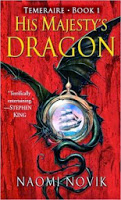
His Majesty’s Dragon by Naomi Novik: Book Review

His Majesty's Dragon begins when Captain Will Laurence's ship has just overpowered a French ship. Napoleon is slowly conquering Europe, so any defeat of the French, no matter how small, is a big deal. As Will's crew is inventorying the French ship's cargo, they find something unusual: a dragon egg. But complications arise when they find out that the egg will hatch in a week and they're about three weeks from shore. Dragons have been tamed in this alternate world and they're used to wreak devastation on the enemy. But they must imprint on their rider within the first few minutes of hatching if they're to be put to harness. That means someone from the ship's crew must step forward and be willing to sacrifice his naval career for the good of England. What a hugely fun fantasy/adventure! There's honestly no ground-breaking literature here, but if you want a good, swashbuckling adventure tale, this is it. I loved the dragon, Temeraire. He was by far the best character overall. It was fun to watch Will grow from being this stick in the mud British sea captain to finally loosening up some and having fun. Somewhat related to that, I loved the very proper British English present throughout the book. I have no idea how accurate is, except that the author is American which probably means it isn't, but sentences like, "Celeritas tells me to ask you to show me about; will you be so good?" just tickled me for some reason. I could just hear the very plummy uppercrust British guys talking. I don't really read military books, and this did sort of cross over to that genre. But the battle scenes were well-written and exciting. I didn't have any problem following what was going on. I did have a…

The Paper Magician by Charlie N. Holmberg: Book Review

Ceony Twill has put herself through magic school in only a year when most people take two. She's a smart girl and she's hoping that her magic will be based on metal. She wants to design weapons and machines and things that matter. Instead, she gets paper. Boring old, get-it-wet-and-it-falls-apart paper. She's crushed. She hopes there's been a mistake. But the powers-that-be say that a balance must be kept so they assign a certain number of students to paper because, let's face it, no one is volunteering for it. Ceony resignedly sets out for her apprenticeship with Magician Emery Thane. Once she gets there, she settles in well enough. Thane is a kind teacher and a talented magician. So when his ex-wife shows up and literally steals the beating heart from his chest, Ceony decides she has to save him. She sets out with her few learned paper magic skills to face the ex-wife, an Excisioner whose magic is based on manipulating flesh. This sounded promising but it also sounded like it could go very wrong. One of my friends loaned it to me, saying, "You'll love it, I promise." For two people who are confirmed bibliophiles, our tastes don't overlap very much so I was still a tad worried. I should have had more faith. I enjoyed this immensely. I was a little unsure of Ceony at first. She seemed to think that she was just too good to be a paper magician. But honestly, I would feel the same way. What can you do with paper? Fold it into an airplane and hope to poke someone in the eye? It turns out there's much more to humble paper than I thought. Once Ceony settled in and set out on her quest, she slowly grew on me and I…

Life After Life by Kate Atkinson: Book Review

Ursula Todd is born on a cold winter's night in England in 1910...over and over again. Sometimes she is stillborn, other times she makes it through, only to die later and start over at the same place. Each time, something is a little different and her life takes drastically diverging paths as a result. Someone asked me what this is about and it's almost impossible to explain. "Reincarnation but...not. She lives the same life over and over but...not really." What matters is watching how minute differences in Ursula's life change her story completely. That was what I really enjoyed. I liked the whole concept of playing with a character's life like that just to see what happens. There were lives that I hated and lives that I loved. Some were depressing, some were horrific, some were odd, but they were almost all interesting. Some got a little crazy. The prelude shows us Ursula, a pretty English girl, setting out to assassinate--a Nazi official (I'm pretty sure it's not spelled out at that point). Where the heck did that come from? Once I got to that life, it did make sense but still--wow. There were a couple of drawbacks though. The book got repetitive. I don't think there was any possible way to avoid that in this kind of story but there you go. I think the author did the best anyone could have but I was still heartily sick of that snowy winter night that Ursula was born. Also, I started having trouble remembering what had happened in each life by the end. "Is this the one where this happened or was it that?" I can't say that I was always entirely sure. The characters weren't a huge draw for me but this is one instance where the story itself…

Season of the Dragonflies by Sarah Creech: Book Review

The Lenore women grow a rare flower that is the secret ingredient in their powerful perfume. Each generation, only a few women are chosen to wear their coveted scent. These women inevitably rise to the top of their professions and become the envy of the world. But Willow, Mya, and Lucia Lenore, the current generation, aren't doing so well. Willow's not as sharp as she once was, Mya would do anything to run the company, and Lucia wants no part of it. They've made a mistake with one of their chosen few and there could be some dreadful consequences to pay. Eh. I really liked the premise of the book. A family of women, the Blue Ridge Mountains (my home), a touch of magic--what's not to love? These characters. Willow and Lucia were okay, but holy cow, I could not like Mya. Not one little bit. The point of view shifts between the three women so it's not like I could really ignore her. I felt like I was getting mixed signals about her. She's the one with the great nose, the talent for mixing perfumes, the magic touch to get it right, and the one that forest animals flock to. She's a regular Snow White. Until she mixes a terrible perfume for their problem child of a crossover pop queen/actress. The actress was being a witch, no doubt about it. But Mya gets way out of line with what she does. Willow was the aging matriarch and I was mostly okay with her. Except that she let Mya have a free rein. Lucia was almost forgettable. She was the broken hearted divorcee who comes back home to the Blue Ridge from New York with her tail between her legs. And that's about all the personality she had. Well, at…

Jane by April Lindner: Book Review

In this modern-day retelling of Jane Eyre, Jane Moore is a penniless student who's just had to drop out of college and take a job as a nanny working for rock star Nico Rathburn. I love Jane Eyre. I love Mr. Rochester. The idea of this book intrigued me. How exactly would all that Gothic deliciousness translate to the modern age? Reasonably well. But first, what didn't work. For me, anyway. For my taste, this book was actually a little too faithful to the original. It was like there was a list of the major events and they were dutifully checked off. Jane as an orphan? Check. Older brother figure locking her in a room overnight? Check. A dog named (Co)Pilot? Check. A chance meeting where Mr. Rochester/Rathburn almost plows over Jane and they argue because she doesn't know who he is? Check. I can't believe I'm saying this, but I somehow would have preferred the story to veer off in its own direction more. I know Jane Eyre. I want to read Jane Moore's story. And then there's the whole...does it even count as a spoiler if you're talking about a well-known twist from a classic? I'll be safe. If you know the story of Jane Eyre, read on. (Highlight below to see what you're missing) Begin possible spoiler: The wife in the attic. There's no reason for that to happen now. Back in Jane Eyre's day, once married, always married. You didn't have many options to get rid of a crazy wife. Nowadays, not so much. The author did what she could, which is definitely more creative than anything I would have thought of, but I still didn't buy it. I couldn't even quite decide exactly why Nico kept her locked up. He said it was because he…

Testimony: The Legacy of Schindler’s List: Book Review

Testimony covers a lot of ground, from the making of the movie, Schindler's List, to the idea of filming Holocaust survivor testimonies, to the actual project, and now sharing the testimonies and collecting new ones from ongoing genocides around the world. The first half of the book kept my attention better than the second half. I love the movie so seeing the behind-the-scenes photos and reading about the actor's thoughts was fascinating. I also liked reading about the real people the characters were based on and how filming such harrowing scenes affected all the cast and crew. When the narrative moved on to the idea of the Shoah foundation and collecting the survivor/witness stories, I was still on board. I liked reading about how the USC Shoah Foundation is sharing their expertise with other groups around the world with similar goals. I was reading in bed wondering how you get a job collecting stories. I even searched StoryCorps to see if they were hiring (They were but I'm not bilingual). The idea of such a huge, important undertaking just appealed to me--no, it called to me. The second half got more technical, focusing on ensuring that the testimonies are secure and stay in a format that is always relevant to the modern age. That started to lose me. I'm proficient with the technology that's relevant to my life. I don't really stay on the cutting edge of anything. And I definitely don't understand anything about movie editing, etc. I do understand that all of this is important but I didn't really follow it. I was back on slightly firmer footing when the narrative switched to sharing the testimonies with the world. Even at that, I quickly got to the point where I just wanted to know what website I could…

Lisey’s Story by Stephen King: Book Review

Scott Landon, award-winning novelist, died two years ago. His wife, Lisey, is finally cleaning out his study. As she goes through his old papers, awards, and photos, buried memories come boiling to the surface. Then she gets a call from a man who tells her to hand over her late husband's unpublished work or face the consequences. What I love best about starting a new-to-me Stephen King is that feeling. If you're a SK fan, you know what I'm talking about. There isn't really a "getting into the story" phase. You're just in it. Right where he wants you to be. And right where you want to be: in the practiced but never predictable hands of a master storyteller. This one didn't let me down. I actually enjoyed this a lot more than Duma Key, the most recent King novel I've read. It's really sort of the story of a marriage: the good times, the bad times, the barely-got-each-other-through-it times. I loved that these characters had their own insiders language. I think most relationships have this, but it's hard for a writer to get it right. I felt like I was right in the middle of a real relationship where the magic words are bool, SOWISA, strap it on, smucking, and Boo'ya Moon. He really just got this so right. I even wondered if he was using catch-phrases from his own marriage. This quote struck me: "Lying in the bed that had once held two, Lisey thought alone never felt more lonely than when you woke up and discovered you still had the house to yourself. That you and the mice in the walls were the only ones still breathing." Don't go into this expecting the freaky, terrifying blood baths that everyone associates with Stephen King. He's grown past that.…

More Than You Know by Beth Gutcheon: Book Review

Hannah Gray is now an old woman, reliving the summer when she was seventeen and in love. She's revisiting her grandparents' house on the coast of Maine and re-reading her journal from that summer. She was fighting with her stepmother, her father was back home in Boston, and the house they had rented was haunted but Hannah was the only one who could see that. She eventually stumbles on the tale of a gruesome murder with ties to the house when it was located on an island out on the bay. In a dual narrative, the book contains Hannah's journal and relates the events surrounding the murder. I really just grabbed this out of a box of books that I borrowed from my aunt a long time ago and haven't finished reading. I glanced at the back and saw something about Maine and decided that sounded good to me. I was surprised to get a murder and a ghost! Don't get the idea that this is a horror novel. There's a lot more going on here than that. The ghost seems to serve more as an illustration of the ways we hurt each other in countless ways, both big and small, and the way that bitterness and anger cause effects that ripple out from us and down through generations. I liked Hannah and thought her parts captured that feeling of being young and in love and knowing that the world is too small to contain everything you feel. She just wants to do what she wants but she has her stepmother constantly trying to clip her wings. And Conary, the boy she loves--he's fabulous. I got the feeling that he could be a heart breaker but he's tender and caring and charming and almost perfect with Hannah. The story about…

The Pearl That Broke Its Shell by Nadia Hashimi: Book Review

Rahima lives in a family of girls. Her father was a fighter for the local war lord in their Afghan village and he's now addicted to opium. With custom demanding that the girls never leave the house without a male family member to escort them, they're struggling. When Rahima's aunt comes to visit, bearing stories of an ancestor, Shekiba, who dressed as a bacha posh and made her way through life as a boy, the answer to their problems appears. Rahima's hair is cut and she becomes Rahim, going to school, running errands, and supporting her family as best she can. My reading doesn't venture outside my own culture as often as it should. When I read books like this, I always resolve to do better and then I don't. I need these reminders of how blessed I am in my life and how difficult it is for others who didn't happen to be born here. Reading about Rahima's years as a bacha posh was pretty easy. Life was better for her and her family. But afterwards... oh my gosh. Things just got worse and worse for her. But this is daily life for a lot of women in a lot of countries. How does life change for them? It always seems like change has to come from within but with this kind of oppression, how does that happen? Even that's addressed a little bit toward the end of the book. The secondary narrative tells of Rahima's ancestor Shekiba. Shekiba may have had an even harder life than Rahima. She's completely alone with only an extended family that seems to hate her for her scarred face. I usually prefer one story over another in a dual narrative like this, but I was almost relieved when the point of view switched.…