The Great Gatsby by F. Scott Fitzgerald: Book Review

Nick Carraway moves from the Midwest to Long Island to try to make a living after World War I. He is curious about his neighbor and the extravagant parties he throws every weekend. Eventually the two meet and become something like friends. The neighbor, Jay Gatsby, is shrouded in myth and legend and no one seems to know where he came from, how he made his money, or anything at all about him for that matter. Gatsby has a very specific reason for living where and how he does and his personal struggle pulls several others into his wake. Like many others, I decided to re-read this before the movie comes out. I disliked it in school but I've changed my mind about almost all the other classics I've bothered to re-read, so I thought I might change my mind about this one too. Not really. If you follow my reviews at all, you know that I am a very character-driven reader. Give me an awesome character and I'm happy. But there is not one likeable character in this novel. I think I kind of liked Nick in high school but now I don't even like him. He's by far the best of the bunch but that's not saying much. Gatsby himself is kind of pitiable. He's worked hard, being pushed constantly by an overweening ambition. He seems to have been born with a desire for more than he has but circumstances cause him to push himself even harder. He surrounds himself with people who don't bother to know him and seems to think that this is what gives a man a full life. Or rather, he thinks its a step on the way to fulfilling his deepest desire. He just made me feel tired and sad. He could have…

The Dress Lodger by Sheri Holman: Book Review

Gustine is a dress lodger (lower class prostitute in an upper class dress) in Sunderland, England in the 1830s. One night she meets Dr. Henry Chiver, a surgeon in disgrace who has promised his small group of students that he will find a human body for them to dissect and study. Unfortunately, there is still a lot of superstition about medicine and doctors and finding a body isn’t so easy. Gustine and Henry enter into an agreement to help each other get what they so desperately want. I tend to be a character-driven reader, and I found that I didn’t really like any of the characters in this book. There were probably one or two that I could have liked, Gustine being one, but that didn’t really seem to be what the author was going for. I think Holman was trying to paint a picture of what life would have been like for the lower classes in that time frame in England, and she truly succeeded with that. She put me inside the story, and I read her well-written, picture-perfect descriptions of the working conditions, living conditions, ignorance, fear, hostility, brutality, and just general misery that described the lives of the working poor of this town and shuddered in revulsion and felt a little lot more grateful for what I have, where I live and when I live. She also succeeded in turning my expectations for the novel and where my sympathies would lie upside-down. I have a bachelor’s degree in biology and work in a hospital: I should have been rooting for Dr. Chiver and the triumph of science all the way through. But slowly, insidiously, I found myself being led in another direction without really even realizing it. Let’s just say that I have a greater appreciation for…

Tears of the Giraffe by Alexander McCall Smith: Book Review

Mma Ramotswe has just gotten engaged to Mr. J. L. B. Matekoni. But she's not going to let a little thing like that change her life too much. She's still running her business and solving mysteries with her unique blend of luck, insight, persistence, and wisdom. I'm missing something. I know I am. Too many people love these books for it to be a fluke. I just don't love them. I don't dislike them either. I don't really feel much either way. I like Mmma Ramotswe herself. She has a kind heart and I love her solutions to problems. I remember her being a little trickier in the first book, but it has been years since I read it, so maybe I'm wrong. Mr. J. L. B. Matekoni doesn't really know what he's gotten himself into. He has a kind heart as well, so I like him with Mma Ramotswe, but I think he's going to get trampled by her personality. Although I was shocked at one big thing he undertakes without first consulting with Mma Ramotswe! I tried this second book in the series on audio, thinking that the stories have a bit of a "spoken word" feel to them. It worked a bit better for me, but I'm still not left longing to read more. The bonus of the audio was that I wasn't constantly tripping over unfamiliar names. I feel perfectly confident saying them now. I thought Lisette Lecat's soft voice was a perfect accompaniment to these simple-on-the-surface tales. I think I'm going to give up on the series now, but if you're interested in them, definitely give them a try. I seem to be in the minority in not loving them. Read an excerpt. My review of the first book, The No. 1 Ladies' Detective Agency…

The Exile of Sara Stevenson by Darci Hannah: Book Review

Sara Stevenson has shamed her family and has been exiled to a remote Scottish island for months. Along with her lady's maid, Kate; Kate's husband; and the lightkeeper, William, she will have to weather a long winter, unsure of the fate of her lover. I thought this was pretty good. It's not exactly my typical read, but I still enjoyed it. My one real problem was that it was a bit too romance-y. There's nothing wrong with that, it's just not my thing. There are some supernatural elements that just took it over the top for me. Don't get me wrong--I love fantasy, it just felt too "Love transcends all" for me. Sara and her maid both irritated me at times. Sara is determined to do the exact opposite of what she's told, to the point that it's stupid and dangerous. "Don't go out today, Sara, a snowstorm is coming." So what does she do? She rides out. Of course. Because who doesn't want to get caught out on the moors or what have you in a snowstorm? She also jumps to some ridiculous conclusions about William and refuses to change her mind about him for an inordinate amount of time. The maid was a little holier-than-thou tattletale. But at least Sara was independent and spoke her mind. I ended up liking her. I liked William too. He's a tortured soul. He can be charming when he wants to be, but in the right mood, he's scary. I had an idea what his story was going to be from early on, but I still liked reading all about him. But then, I do like me a good Scottish man! I wish I could remember more details, but I don't. Fans of Susanna Kearsley should give this one a try. Read…

Mermaids in the Basement by Michael Lee West: Book Review

Renata DeChavannes is reeling from personal loss. She runs home to her grandmother in Alabama, seeking answers to questions about her mother. I don't have a lot to say except that I can't help but feel like this has been done before. Younger generation, digging in the past, looking for parents' secrets. Sound familiar? I'm thinking of Divine Secrets of the Ya-Ya Sisterhood, and this book is nowhere near as good as that one. I liked most of the present-day characters. Renata was pretty funny, but apparently pretty dense, but Honora, Gladys, and Isabella were tons of fun. Unfortunately, they weren't really the focus of the story. The focus is on Renata's mother Shelby and her broken relationship with Renata's father, Louie. Everyone talks about Shelby like the only reason she didn't walk on water was because she didn't want to, but once the past starts coming out, I couldn't stand her. I really don't get what was up with Renata. She's about 30 years old, but you would think that she was five. She seems to know absolutely nothing about family history, even when she's directly involved. An explanation was given, but it was pretty weak. And everyone's supposed to be telling her these old family stories, but when they start talking, it's like Renata's not even there. Instead of, "You weren't a very pretty baby," it's "Renata wasn't a very pretty baby." What's up with that? The chapters float around between several of the present-day characters. Some of them are titled, "Honora says..." and that made it pretty clear who was talking. But sometimes that was left off and I would think Renata was telling a story only to find out that it was her father. Confusing. I'm making this sound bad, and it really wasn't. It was…

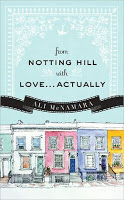
From Notting Hill With Love…Actually by Ali McNamara: Book Review

Scarlett O'Brien dreams that her life will one day become just like a romantic comedy. Her friends and family worry about her because she seems to be dissatisfied with the life she has because of her obsession with the movies. She's engaged to be married in a couple of months but she just doesn't seem to be very excited at the prospect. When the opportunity to house-sit in Notting Hill comes along, everybody, including Scarlett, thinks it's a great idea. Those who care about her think it will give her time away from her fiance to think about what's really important to her. Scarlett is excited because it's the setting of her favorite movie. And what better place to live scenes from a movie and prove to her loved ones that life really can be like the movies? This was cute but the underlying premise felt weak. I would be rocking right along, enjoying all Scarlett's misadventures and then something like, "Yet another movie moment for my collection! I knew I'd show everyone!" would come up. It was unnecessary and because of that, it kept pulling me out of the story. I think this could have been slightly re-worked to change that foundation and made into a stronger book. That aside, I really did enjoy it. I liked Scarlett a lot when she wasn't trying to orchestrate a scene from Pretty Woman or Sleepless in Seattle. She is an insecure dreamer who feels like she's missed out on something by never knowing her mom. She has a great group of friends and she actually knows it. And I mostly like her taste in movies. Luckily, there was an index at the end that listed them all. I'm in the mood to watch a lot of them again after reading this.…

Prayers for Sale by Sandra Dallas: Book Review

Eighty-six-year-old Hennie Comfort meets 17-year-old Nit Spindle when she sees the young woman standing outside one day, contemplating an old sign hanging on her fence advertising "Prayers for Sale." Hennie takes the newly-arrived woman under her wing, showing her how to survive in a Colorado mining town in the '30s and passing on her vast collection of stories. At heart, this was a sweet story about the friendship between women, friendship between generations, forgiveness, aging, and a life well-lived. There were some very dark stories, but I finished with a smile on my face. Hennie was a great character and someone I would like to know in real life, but a few things bothered me. This was written with a bit of a dialect and it didn't ring true to me. Maybe it's because I'm used to reading a Southern dialect. Maybe because it's about two Southern women who live in Colorado, so their speech patterns have changed. But really I just think it got close enough to being right to really stand out as being wrong. There's a mystery running throughout the book, and I have to say that I was surprised when I found out what was going on. But we read Hennie's thoughts throughout the entire book, and whenever she got close to the big mystery it all of a sudden got vague. An example--NOT a quote: "Hennie thought she would put some some chili on the stove. She thought about how much Jake used to like chili. She thought she'd soon have to do something about that one last thing that was bothering her." What?!? I've seen that far into her thoughts, so it feels like a cheap trick to hide one thing to build some suspense throughout. Hennie thinks that she has a few problems…

Anya’s Ghost by Vera Brosgol: Book Review

Anya falls into an abandoned well one day and finds herself alone with a skeleton. Needless to say, she is terrified. Especially after the ghost of a girl about her own age shows up. Anya is rescued fairly quickly and tries to put the whole experience behind her. But she's brought something back out into the daylight with her--the ghost. And Emily has no intention of going back into the darkness. I was okay in high school. I really was. I had a group of awesome friends and we had a good time just doing our band geek thing. Still. I wouldn't want to be a teenager again. So books that bring those years so painfully to life just don't do much for me. And Anya's teenage years are painful to see. She's a second-generation Russian (I'm 99% sure) immigrant. She's so ashamed of it. She hates being around her family and seeing the ways that they're different from other families. She hates being around a boy her age who has only recently left Russia and so has a heavy accent. She's ashamed of the food they eat and the clothes she wears and even her sturdy Russian body. She's got issues. But Emily helps her to see exactly how ridiculous those feelings are. And not at all in the way that I expected. Emily just got freakier and freakier until she was downright scary by the end! She shows Anya exactly where her attitude could lead her and it is a dark, lonely, and psychotic place. I truly liked the artwork and I wish I had liked the story more than I did. It's just that teen angst thing. If you are more forgiving of it than I am, pick this up. It is a creepy little book that…

White Indian by Donald Clayton Porter: Book Review

The Great Sachem of the Seneca tribe has lost his infant son. In grief, he joins an alliance of tribes in making war on other tribes and an English settlement. In the settlement, he finds a baby boy, only a few days old, who looks at him fearlessly even though the mother has just been killed. The Sachem decides that this brave boy will become his son, so he takes the child home and raises him to become the best fighter and the wisest man of his generation. His name is Renno. As the Seneca and the settlers encounter each other more and more over the years, it becomes apparent to both that their individual needs can best be met by an alliance. Who better to form the basis of that alliance than Renno, a man with ties to both worlds? Obvious thing first: the book wasn't very politically correct. Just look at the title: White Indian. What should it be? Caucasian Native American? I don't know. But that was the first thing to jump out at me. Overall though, I enjoyed the book. I liked the characters and the descriptions of their ways of life, both settlers and Native Americans. The pace was good overall, only occasionally getting bogged down in description. I could have used more dialog. The book was based more on description of action than dialog, and I really do like dialog more. Fans of westerns will like this one, even though it's not a true western (I think more of the settlers in California or New Mexico when I think of westerns). I'll keep reading the series. Reviewed October 14, 2008 Friday Flashback Reviews are a weekly feature here on The Introverted Reader. These are old reviews I wrote on GoodReads. Thanks to Angieville and…

Don’t Know Much About Mythology by Kenneth C. Davis: Book Review

Author Kenneth C. Davis sets out to fill in the gaps of the average reader's knowledge of mythology. Don't expect a book of stories about Zeus and Hera; they're here but so are gods from Egypt, Celtic lands, Africa, the Americas, Asia, India, and just about every culture you can think of. This was not what I expected. I thought I was getting something along the lines of Edith Hamilton's Mythology--the actual myths in one big collection. I should have paid more attention to the subtitle, "Everything You Need to Know About the Greatest Stories in Human History but Never Learned" (emphasis mine). Davis definitely took a historical approach to all these legends and myths. It was interesting and I learned a lot, but it wasn't necessarily what I was looking for. Each part began with a timeline of important events for a specific culture or country and then there were a series of questions about the mythology. Most of the answers were framed in history. It makes sense, but it didn't make for very riveting reading for me. There were also little sections called "Mythic Voices" that did excerpt as directly as possible from the original sources. A list of the important gods/spirits/tricksters/etc. and a brief synopsis of each god's most significant stories was at the end of each part. These were my favorite bits but they felt like afterthoughts. I was pleased when I realized that lesser-known cultures were included, but they were necessarily vague. I'm specifically thinking about the sections on Africa, the Americas, and the Pacific Islands. There are a lot of different peoples living across a big area and they didn't necessarily have the same beliefs. Davis did what he could to draw out their commonalities and focus on those. He was hampered by the…