Maus I: A Survivor’s Tale: My Father Bleeds History by Art Spiegelman: Book Review

Art Spiegelman’s father, Vladek, was a Jew living in Poland in WWII. He made it through, and Maus I is Spiegelman’s story of his father’s life, as well as an exploration of the way the lives of the survivors and their family members were never the same. Okay, let’s look at the fact that this is a graphic novel first. It absolutely works. The Jews are mice, the Germans are cats, the French are frogs--you get the idea. This is a young adult book, so I think that helps kids/teens deal with the story a little better. A skeletal mouse is alarming enough, but it would be so much harder for a child to deal with if it had been a photo of a skeletal person. As an adult who knows something about what happened, I found that the form made me see with new eyes. We’ve all seen “Schindler’s List” or read one of the books written by survivors. But this form somehow hit me a little harder, almost as if I were learning about the Holocaust for the first time. It still stays true to the horror and atrocity. Some of it is sort of passed over, but the moments when the violence is shown stand out that much more. I’ve read quite a few Holocaust novels, but the moments of random violence in Maus I hit me hard. Spiegelman took the “less is more” approach and it worked. There were so many things I liked about this book. The historical part of the story opens with Vladek as a reasonably prosperous young mouse marrying into a wealthy family. I liked that this is where it started. I got to see how everything was slowly stripped away until they were desperate for any shelter and any food. That…

Number the Stars by Lois Lowry: Book Review

Annemarie Johansen is a 10-year-old girl growing up in Denmark during WWII. Soldiers occupy every street corner and everyone does his or her best not to draw attention to themselves. Annemarie's best friend, Ellen, is a Jew. One night, Annemarie's family hides Ellen from soldiers who are looking for Jews. How far is the family willing to go to provide that protection? How brave can they be? I don't know how I didn't ever read this in school. Well, I guess I do now that I looked at the copyright date. :( Published in 1989, I was probably a little too old for it by the time it truly came to the attention of teachers. Anyway, I would probably have liked this just a bit more had I read it when I was younger. I do read YA and MG books, but I gravitate toward fantasy. I don't always fully appreciate the realistic books. I have to say that I did like this, even coming to it late. I can see how it makes a good introduction to the Holocaust for younger readers. There's plenty of fear but very little violence. The fear is even vague. No one is talking about camps or ovens. I like that everyone involved is just an ordinary person. When so many of our "heroes" today are lionized to the point of seeming to be superhuman, it's nice to be reminded that true heroes are ordinary people doing their best in extraordinary circumstances. That gives everyone room to be a hero. One thing I did like, and I'm sure kids relate to, is that Annemarie gets to play her own heroic part. She is scared and she questions her own bravery, but her family entrusts her with a big responsibility when it becomes obvious that…

The Zookeeper’s Wife by Diane Ackerman: Book Review

Jan and Antonina Żabiński were the keepers of the Warsaw Zoo when Germany invaded Poland. Between the bombing, Nazi cruelty, and the Nazi desire to keep all of the rare animals for themselves, there quickly wasn't much of a zoo to keep. But Jan was an ingenious thinker and he came up with various ideas to keep the zoo complex under his care. From community gardens to a pig farm to a fur farm, he always had the zoo under his control. He was deeply involved in the Polish Underground, and as part of his efforts, he moved hundreds of Jews through his zoo on the way to safer ground. This wasn't exactly what I was expecting, and that was both good and bad. Generally coming at WWII through the Holocaust, I mainly think of Poland as the home of Auschwitz and the worst of the concentration camps. That's as far as I take it. I've never given any thought to the fact that Germany invaded Poland first and kept the Poles brutally repressed throughout the duration. Diane Ackerman showed me how bad it was for the Poles. My problem was that I expected more of a narrative about life in the zoo, but the story was all over the place. There was actually very little about the zoo and the Jews in hiding there. A few who stayed for a while were written about, but that was about it. The rest of it bounced around a lot. There was a constant thread about the Żabiński family and how they made it through the war. But then there would be paragraphs about girl couriers helping the Underground, a pediatrician who refused to escape because he didn't want to leave the children in his orphanage, random people in the Underground and…

Corelli’s Mandolin by Louis de Bernières: Book Review

Pelagia is a beautiful 17-year-old girl living on the Greek island of Cephallonia when World War II breaks out. The Italians eventually occupy the island and that's when she meets Captain Antonio Corelli, a man who joined the Army because he thought it would give him plenty of time to practice his mandolin. There were about 100 pages when I was enchanted by this book, from about page 250-350. Everything else was just okay. The author is a beautiful writer. He's very poetic and his images just leapt to life for me. He's also a very intelligent, multi-lingual writer and my vocabulary, which I think is probably better than average, was not up to the task. Aside from obscure English words, there were bits of Greek, Italian, French, and a smattering of German thrown in for good luck. Wow. I could generally figure out what was going on, but reading this was a little too much like work in some parts. The book is told from many, many, points of view and each voice is very distinct. That's very hard to pull off, so he did get huge points for that. He also has a little bit of the whole Catch-22 thing going on. He shows you the absurdity of this whole war--well, this part of it, anyway--very plainly. But where Joseph Heller chose to show the horrible side of war in a very graphic injury that you've read about for a while before you find out what it is, de Bernières horrifies you and then breaks your heart in a couple of scenes that are ultimately tearfully, achingly beautiful. I'm not a crier, but even I welled up a little. He shows that while war can be absurd, it's also ugly, but our more-human moments shine all the more…

The Ice Soldier by Paul Watkins: Book Review

William Bromley is a World War II veteran living in 1950's London. In the war, he led a mountaineering expedition that ended disastrously. He has never moved past this and started living again. He's just existing--teaching school, admiring the secretary from a distance, spending Friday evenings with his one friend, and visiting his father on school breaks. There's nothing exciting in his life and that's the way he likes it. Notably, he has also completely given up mountain climbing. Then something changes and he is left wondering if his life is really enough and does he have the courage to start truly living his life again? I enjoyed this. The story itself was very well-written and easy to read. The pacing was good and the way that things were slowly explained really worked. Probably the best part was that within this very straightforward story, the author manages to explore big themes like man vs. nature, the nature of friendship among men, and what war can still do to those lucky enough to survive. In other words, it works on many levels. If you want a simple adventure story, that's in here. If you want something to chew over and think about for a while, that's in here too. Reviewed June 21, 2008

Annexed by Sharon Dogar: Book Review

In Annexed, author Sharon Dogar imagines what life in the Annex with Anne Frank must have been like for young Peter. We know all about Anne's thoughts and feelings, but surely Peter needs a chance to tell his side of things too. The novel begins as Peter is dying and looking back on his life, desperate to tell someone his story. The first part of this book was really about 4 stars for me. It wasn't anything hugely different from what I would have imagined, but it was nice to see a different perspective on the other housemates. Anne frequently used her diary as a place to vent, so we tended to see the worst parts of everyone. In this book, Mrs. van Pels is shown as a caring mother who frequently says inappropriate things to help draw attention away from shy Peter. She steals the Franks' sheets to help him out too. His dad makes his awful jokes as a way to try to break tension. Mr. Frank is a wise, understanding mentor. Margot is inscrutable, but Mrs. Frank and Mr. Pfeffer are still pretty difficult to live with. Anne herself isn't always easy to live with, with her high ideals and mercurial personality, but she always makes life interesting, even within the confines of the Annex. The second part left me feeling shattered. Anne Frank's diary is a difficult read, because you do know how the story ends. But the diary just stops and, in the edition I read anyway, there was a very dry summation of what happened to the inhabitants of the Annex after their capture. If you've read any Holocaust literature at all, you can fill in the blanks, but it's easy just to not think about it and feel sad that Anne didn't live…

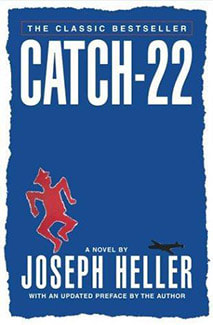
Catch-22 by Joseph Heller: Book Review

This is the story of Captain Yossarian, who is serving in World War II as a navigator on a bomber based in Italy. Yossarian is caught in a "Catch-22" where he wants to be grounded, but he can only get out of flying more missions if he's crazy, but if he was crazy, he wouldn't mind flying missions. The book really skips around, so that you're never quite sure whether you're reading something that happened in the past, or if the story has now moved forward from the beginning point. But it's not really confusing, it all does make some sort of sense in the end. Don't let the whole "World War II bomber" thing mislead you. The book is generally one big farce, that, to me, has an underlying theme about the absurdity of war. I read this when I was a senior in high school. I remember enjoying it then, and I enjoyed it this time. It was a little bit of a different experience this time around. The first time I had no idea what to expect, so the humor was generally more humorous and the suddenly serious parts were definitely more of a slap in the face. This time, I have a few more years on me, so I can appreciate the frustration of bureaucracies and "superiors" who don't have any idea what they're doing. And, knowing what it was that broke Yossarian gave everything a little bit of a different feel. There was one part that just went on too long. It moved past funny and got into tiresome. Other than that, I just loved it. Reviewed December 6, 2007 and slightly revised September 24, 2010 According to the American Library Association website, Catch-22 was "banned in Strongsville, OH (1972), but the school board's action…

Skeletons at the Feast by Chris Bohjalian: Book Review

5 Stars. This was absolutely amazing. I just grabbed this at the library because I remembered it was on my to-read list, but I had forgotten what it was about. Once I read the book jacket, I was so excited. I told my husband, "This sounds like a book I can sink my teeth into!" I wasn't disappointed. The best part about the book [...]

The Diary of a Young Girl by Anne Frank: Book Review

Any kind of synopsis feels extremely redundant, but I'll write one anyway. Anne Frank is a young Jewish girl in hiding in Amsterdam during WWII. I don't know how I made it to be 31 years old without reading The Diary of Anne Frank. I'm glad I finally got to it though. I think Anne's diary made the Holocaust real to me in a way that other books haven't because she is a typical teenage girl in a lot of ways. She's growing up, she dislikes her family and "roommates" one day and adores them the next. She's dreaming about the future, love, a career, and what she really wants out of life. She was funny, she was sad, she was introspective, she was growing, she was intelligent, she was scared, she was brave. She was a great big bundle of glorious possibilities. I wouldn't go back to my teenage years, but I remember feeling all the things she describes. SPOILERS IF YOU SOMEHOW DON'T KNOW ANYTHING ABOUT THIS BOOK As I read, especially the older Anne got, I just kept mourning her. I thought she was a talented writer, especially for her age. She had such strong ideas about a woman's life and career and family. I really felt like, at least in a small way and maybe in a big way, the world lost something special when we lost her. I know that's the case with all the Holocaust victims, but I just felt it more with Anne since I spent so much time in her head. She had it in her to make a mark on this world. I truly believe that. I kept reading slower and slower, the closer to the end I got. I knew what was coming, but I somehow felt that if I…

Night by Elie Wiesel: Book Review

Honestly, I can't help but feel that for me to sit in judgment of a memoir of the Holocaust would be terribly presumptuous. We can't ever forget the Holocaust, and any work that reminds us of what happened is important and should be read as widely as possible. The style is a little sparse for me, but do we really need lavish descriptions of crematoriums? I didn't think so. What is important is that Wiesel laid out his thoughts and feelings for all the world to see, an act of unimaginable courage. It is amazing to me how quickly he and the other prisoners were stripped of their very humanity. It is also amazing how tiny acts of kindness stand out in his memory. But we all know those were too few and far between. Just read this. Today, April 11, 2010, is Holocaust Remembrance Day. Six million Jews were killed in WWII.  Six million. How do we even begin to wrap our minds around that kind of loss? It's as if everyone in the cities of Los Angeles and Chicago were gone. No longer there. Because of violence and ignorance and prejudice. We cannot forget the loss of these people.  The Jewish people are the chief mourners, but we should all mourn their loss.  The victims weren't "only" Jews, they were citizens of the world.  My world.  Your world. Our world. Who knows how things might be different now if such a staggering loss hadn't occurred then? Read Elie Wiesel's 1986 Nobel Peace Prize acceptance speech. Visit the US Holocaust Museum's Days of Remembrance page. Visit the US Holocaust Museum's Holocaust Encyclopedia. Here are links to other books I've read, both fiction and non-fiction, that focus on the Holocaust. Maus I: A Survivor's Tale: My Father Bleeds HistoryMaus II:…