The Mysterious Howling by Maryrose Wood: Book Review

I seriously did not think I could love an audiobook performance more than I love Katherine Kellgren's narration of the Bloody Jack series by L. A. Meyer. And then she narrated The Mysterious Howling. Holy cow. I am in awe of Ms. Kellgren's talent! Old men, teen girls, simpering married women, wolfish children howling at the moon, she went at all of them with gusto and I loved every minute of it! Miss Penelope Lumley has just graduated from the Swanburne Academy for Poor Bright Females. She has no family but her headmistress encourages her to apply for a position as governess to three children at Ashton Place. She seems perfect for the job since she is (obviously) a bright student and (not so obviously) an animal lover, a trait specifically requested of job-seekers in the advertisement. Miss Lumley sets off for her interview, finds herself hired on the spot, and soon learns that the three children given to her care were found in the woods within the past week. They have apparently been raised by wolves and don't speak a word of English between them. But a Swanburne girl is more than a match for any task and Penelope sets about teaching them a love for poetry, phrases of polite conversation, and the fine art of ignoring irrepressible squirrels. I loved these characters. Miss Lumley simply doesn't see that she might have an impossible job before her. She has been hired to teach these children and teach them she will. When Lady Ashton gives her ever more Herculean tasks to accomplish, she simply tackles them the best way that she knows how. She genuinely cares for the children and has their best interests always at heart. The children, Alexander, Beowulf, and Cassiopeia, are little scene-stealers. They are remarkably intelligent,…

Throne of Jade by Naomi Novik: Book Review

Captain Will Laurence and his dragon, Temeraire--or is it the other way around?--are in something of a bind. Temeraire was meant to be a gift from the Chinese emperor to Emperor Napoleon. The Chinese people are not happy when they find out that Temeraire is a mere captain's pet and he's being used to wage war on France. To resolve the issue, Laurence, Temeraire, their flight crew and a diplomatic delegation are sent on a journey to China. This did feel a little like filler. But it was such fun filler that I didn't really mind. The pacing was just a little off. The whole point is supposed to be resolving this conflict, but most of the book is taken up with the journey. All of that was mostly pretty interesting, but the best part was the part that takes place in China--only the last third of the book. I would have preferred more of that. It was really cool to read about how the dragons and people interact in China. It's not like Britain, that's for sure. Novik came up with this whole different dragon culture that fit in with my vague ideas of Chinese culture. All those parts were really fun to read. Temeraire's special fighting ability continues to crack me up. It's not supposed to be funny, but I find the whole idea so ludicrous that it's funny to me. Don't ask me why I'm willing to believe that a dragon can fly around with a crew of something like 15-20 men running around on his back, but I draw the line at this. I just do. But I mostly accepted it and just read this for a good yarn. Laurence has finally learned to loosen up. He was such an uptight stick in the mud that…

The Buddha in the Attic by Julie Otsuka: Book Review

Chronicling the lives of Japanese brides coming to America, Buddha in the Attic is deceptively slim. Almost every sentence begins a new story that is only hinted at, yet I saw at least the broad strokes of an entire life in just those few words. There is no main character and the book is told collectively. (NOT a direct quote) "We came from Japan. We left our remote farms. We left our lives in Tokyo. We left our fishing villages. We cried as we left our families. We left happily, vowing to never look back." Listening to this on audio, the style bothered me a bit at first. It's so freaking repetitive! I do not do well with anything repetitive. Once I did settle into the narrative, I saw the beauty of it. In about four hours, I was a part of the lives of what felt like hundreds of Japanese women, each with her own story. The book starts with the young women on the boat, uncertain of their futures and their husbands. They've never even met the men they're traveling halfway around the world to marry. Then there's early married life, children, life as an immigrant, and, in the early years of WWII, life as a "traitor." It was sometimes heart-breaking but always thought-provoking. Samantha Quan narrates beautifully. I've not been a big fan of Carrington MacDuffie's straightforward narration in the past but it worked very well for her small part in this book. I might have rated this higher in print, despite the excellent narration, simply because I could have skimmed over the seemingly endless, "We came from"s and "We gave birth in"s. In whatever format you choose, this is an excellent little book and I do recommend it. Read or listen to an excerpt. Find author…

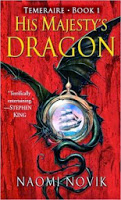
His Majesty’s Dragon by Naomi Novik: Book Review

His Majesty's Dragon begins when Captain Will Laurence's ship has just overpowered a French ship. Napoleon is slowly conquering Europe, so any defeat of the French, no matter how small, is a big deal. As Will's crew is inventorying the French ship's cargo, they find something unusual: a dragon egg. But complications arise when they find out that the egg will hatch in a week and they're about three weeks from shore. Dragons have been tamed in this alternate world and they're used to wreak devastation on the enemy. But they must imprint on their rider within the first few minutes of hatching if they're to be put to harness. That means someone from the ship's crew must step forward and be willing to sacrifice his naval career for the good of England. What a hugely fun fantasy/adventure! There's honestly no ground-breaking literature here, but if you want a good, swashbuckling adventure tale, this is it. I loved the dragon, Temeraire. He was by far the best character overall. It was fun to watch Will grow from being this stick in the mud British sea captain to finally loosening up some and having fun. Somewhat related to that, I loved the very proper British English present throughout the book. I have no idea how accurate is, except that the author is American which probably means it isn't, but sentences like, "Celeritas tells me to ask you to show me about; will you be so good?" just tickled me for some reason. I could just hear the very plummy uppercrust British guys talking. I don't really read military books, and this did sort of cross over to that genre. But the battle scenes were well-written and exciting. I didn't have any problem following what was going on. I did have a…

The Paper Magician by Charlie N. Holmberg: Book Review

Ceony Twill has put herself through magic school in only a year when most people take two. She's a smart girl and she's hoping that her magic will be based on metal. She wants to design weapons and machines and things that matter. Instead, she gets paper. Boring old, get-it-wet-and-it-falls-apart paper. She's crushed. She hopes there's been a mistake. But the powers-that-be say that a balance must be kept so they assign a certain number of students to paper because, let's face it, no one is volunteering for it. Ceony resignedly sets out for her apprenticeship with Magician Emery Thane. Once she gets there, she settles in well enough. Thane is a kind teacher and a talented magician. So when his ex-wife shows up and literally steals the beating heart from his chest, Ceony decides she has to save him. She sets out with her few learned paper magic skills to face the ex-wife, an Excisioner whose magic is based on manipulating flesh. This sounded promising but it also sounded like it could go very wrong. One of my friends loaned it to me, saying, "You'll love it, I promise." For two people who are confirmed bibliophiles, our tastes don't overlap very much so I was still a tad worried. I should have had more faith. I enjoyed this immensely. I was a little unsure of Ceony at first. She seemed to think that she was just too good to be a paper magician. But honestly, I would feel the same way. What can you do with paper? Fold it into an airplane and hope to poke someone in the eye? It turns out there's much more to humble paper than I thought. Once Ceony settled in and set out on her quest, she slowly grew on me and I…

Life After Life by Kate Atkinson: Book Review

Ursula Todd is born on a cold winter's night in England in 1910...over and over again. Sometimes she is stillborn, other times she makes it through, only to die later and start over at the same place. Each time, something is a little different and her life takes drastically diverging paths as a result. Someone asked me what this is about and it's almost impossible to explain. "Reincarnation but...not. She lives the same life over and over but...not really." What matters is watching how minute differences in Ursula's life change her story completely. That was what I really enjoyed. I liked the whole concept of playing with a character's life like that just to see what happens. There were lives that I hated and lives that I loved. Some were depressing, some were horrific, some were odd, but they were almost all interesting. Some got a little crazy. The prelude shows us Ursula, a pretty English girl, setting out to assassinate--a Nazi official (I'm pretty sure it's not spelled out at that point). Where the heck did that come from? Once I got to that life, it did make sense but still--wow. There were a couple of drawbacks though. The book got repetitive. I don't think there was any possible way to avoid that in this kind of story but there you go. I think the author did the best anyone could have but I was still heartily sick of that snowy winter night that Ursula was born. Also, I started having trouble remembering what had happened in each life by the end. "Is this the one where this happened or was it that?" I can't say that I was always entirely sure. The characters weren't a huge draw for me but this is one instance where the story itself…

The Pearl That Broke Its Shell by Nadia Hashimi: Book Review

Rahima lives in a family of girls. Her father was a fighter for the local war lord in their Afghan village and he's now addicted to opium. With custom demanding that the girls never leave the house without a male family member to escort them, they're struggling. When Rahima's aunt comes to visit, bearing stories of an ancestor, Shekiba, who dressed as a bacha posh and made her way through life as a boy, the answer to their problems appears. Rahima's hair is cut and she becomes Rahim, going to school, running errands, and supporting her family as best she can. My reading doesn't venture outside my own culture as often as it should. When I read books like this, I always resolve to do better and then I don't. I need these reminders of how blessed I am in my life and how difficult it is for others who didn't happen to be born here. Reading about Rahima's years as a bacha posh was pretty easy. Life was better for her and her family. But afterwards... oh my gosh. Things just got worse and worse for her. But this is daily life for a lot of women in a lot of countries. How does life change for them? It always seems like change has to come from within but with this kind of oppression, how does that happen? Even that's addressed a little bit toward the end of the book. The secondary narrative tells of Rahima's ancestor Shekiba. Shekiba may have had an even harder life than Rahima. She's completely alone with only an extended family that seems to hate her for her scarred face. I usually prefer one story over another in a dual narrative like this, but I was almost relieved when the point of view switched.…

Sovereign by C. J. Sansom: Book Review

Matthew Shardlake has been summoned by Archbishop Cranmer to assist with some law work as King Henry makes a royal progress through the rebellious north. He must also try to keep a prisoner alive for later questioning. But conspiracies still abound in the area and Shardlake's life is endangered when he stumbles onto something. Reading this felt like slogging through the mud created by the never-ending rain in the book. It just dragged on and on and on. Finally, in about the last hundred pages, the action picked up and everything started to get interesting. I enjoyed reading more about Shardlake and Barak, but overall, I have a lot of problems with the book. There were a lot of typos that drove me crazy. The Bealknap case (remember that from Dark Fire?) is still. dragging. on. C'mon and let it die already! With Shardlake being in the barbarous north, he obviously doesn't really understand the dialect. The explanation of some of the more common terms was unbelievably clumsy. One character basically says out of the blue, "Oh, by the way, old boy, did you know that gate means street up here?" Yes, it really was that bad. Reading this so soon after Ken Follett's The Pillars of the Earth was actually pretty interesting. In Pillars, we get to see how important the monasteries are and the hard work that goes into building a cathedral. In Sansom's books, the pendulum has swung the other way and they're being destroyed. I've never really thought too much about how much art, architecture, and history was lost in these kinds of purges, but the juxtaposition of the two books really brought that home for me. I'll keep reading, and if you've read the others, I would recommend you do the same. It was still…

The Orchardist by Amanda Coplin: Book Review

Talmadge is in town selling the fruit from his orchard one day when he notices two girls watching him. They're very young and very pregnant. He dozes off for a few minutes and wakes as the girls run away with some fruit they've stolen. He decides not to chase them because they look hungry. A day or two later, the girls show up at the orchard. He starts cooking extra food and leaving it out for them but they won't let him get too close. Meanwhile, a stranger shows up in town looking for girls who sound an awful lot like the two Talmadge is watching over. Talmadge ponders things for a while and decides to meet with the stranger at his homestead. Talmadge does not like what he sees. The man, Michaelson, eventually offers to let Talmadge have 20 minutes with a nine-year-old girl for $2. Talmadge quickly leaves, resolved that Michaelson will never get his two girls back. I really liked this on audio. Narrator Mark Bramhall's rough voice suited the feel of the story perfectly. I got frustrated with the book though. A large part of it centers around Talmadge trying to find the youngest girl, Della, after she's grown up and left home. Della doesn't seem to give a flip about anything at that point, and she definitely doesn't care that she's breaking his heart. I tried to tell myself that she'd been through unimaginable things and I needed to cut her some slack but I couldn't. Then I would try to remind myself of the Prodigal Son and the parable of the lost sheep and that still didn't work (I don't know what it was about this book that brought out the Biblical references; it's not remotely religious). Della doesn't want to be found and…

Salt by Isabel Zuber: Book Review

Title: SaltAuthor: Isabel ZuberGenres: Historical Fiction, Southern LiteratureFormat: Paperback Synopsis: John Bayley meets Anna Stockton when she's in her late teens. He decides right away that he's going to marry her. She looks to be a strong woman who knows how to work. After burying two wives, that combination appeals to John. The rest of the book follows the ups and downs of their marriage and their relationship to the land. Review: My biggest issue with this book was that I somehow felt like I was watching a silent movie as I read it. I felt very much outside the story. I got the feeling that this was done on purpose so that I the reader would be more focused on what the author was trying to show me rather than on how I felt about each character or event. It was effective, but I do like to feel a connection to the characters I read about, so it wasn't a style I cared for. There was a lot going on in this book. The point didn't really seem to be the story itself, but rather to explore man's relationship to nature and also man's relationship to other men. What I took away was a message about humanity's need to dominate our surroundings and how futile that need is. Nature will win in the end. I also took away a message about the futility of our hopes and dreams and how we are ultimately so impermanent that we will be nothing more than a fleeting memory. This is all true, but it's a little bleak for my taste. The author is a poet and it shows in her lyrical, yet succinct prose. She says a lot in such a relatively short book, but she says it beautifully. Salt left me…