
The Somnambulist by Jonathan Barnes: Book Review

The Somnambulist features Edward Moon, a conjurer most easily compared to Sherlock Holmes, but with a freakish twist. His Watson is an 8-foot-tall mute man named--can you guess?--The Somnambulist. The pair are asked to investigate a bizarre murder in the seamier part of London at the beginning of the novel. Within pages, they have solved the murder. Or have they? This was a quick, enjoyable read. The characters may have seemed a little like stock characters at first, but they almost always turned out to be something other than they appeared. The plot was well-paced and, for me anyway, the mystery was pretty unpredictable. But, be warned. I picked this up thinking that it might be like The Alienist but set in London with a few sideshow freaks. It starts out that way, but by the end, the book wanders into solid fantasy. That wasn't a problem for me because I am a huge fan of fantasy, but I know that's not the case for a lot of mystery fans. But it did go a little over the top for me, which is part of why it's 3.5 stars instead of 4.5. Also, I was left with a lot of unanswered questions. I like to have everything pretty tidily resolved at the end. I can't even figure out why the book is titled The Somnambulist instead of The Conjurer except that it sounds cooler. If nothing else, read the first chapter of this book. It's only about a page long. Read it while you're browsing the bookstore or the library. This was the best first chapter I've read in a long time. Here's the first paragraph: "Be warned. This book has no literary merit whatsoever. It is a lurid piece of nonsense, convoluted, implausible, peopled by unconvincing characters, written in…

Behemoth by Scott Westerfeld: Book Review

POSSIBLE SPOILERS FOR LEVIATHAN Now that Great Britain has officially entered World War I, Deryn and Alek find themselves official enemies. Alek knows that he has to escape the Leviathan before his secret is out and he becomes an ultra-important prisoner of war, and Deryn knows that she has to let him go. The two find themselves in Constantinople (or is that Istanbul?), where the Germans are making trouble for the Brits, and developing a weapon that could be devastating for the Leviathan. Can Alek prevent a war, and can Deryn save her beloved ship? I am still loving this series. Deryn is such a feisty character. She's super-intelligent, practical, and not afraid to do the right thing. She's also finding it harder and harder to keep her identity a secret from Alek. Her solutions to problems are always ingenious and she just leaps off the page for me. I don't have quite as much to say about Alek. I like him, but compared to Deryn, he's kind of boring. A new character, Lilit, is introduced in this book, and I loved her too. She's a lot like Deryn, but she's able to live as a girl and still show the boys a thing or two about driving Clanker machines. She's fantastic and I hope we see more of her. The action just didn't let up, and I was always interested to see how things were going to work out. The ending was a bit weak because I thought it just stopped. I actually flipped forward and backward a few times on my nook to make sure I hadn't missed anything. As far as I can tell, I didn't. It just ended. Not exactly on a cliffhanger, but just in an odd place. I received an e-galley from the publisher,…

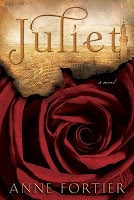
Juliet by Anne Fortier: Book Review

Julie Jacobs is stunned the day she finds out that her great-aunt Rose, who raised her and her twin sister Janice, has died. She's even more surprised when she finds out at the funeral that her real name is Giulietta Tolomei and Rose wanted her to go back to Siena, where she was born, and find a treasure that her mother left for her in a safety deposit box. Of course things are never that easy in real life or in fiction. Julie is soon in the middle of a treasure hunt, being pursued by ruthless treasure hunters, and wrapped up in the long ago story of Romeo and Juliet. Overall, I just loved this. It was full of excitement and suspense and romance and Italian scenery and Siena and gelato, and just so much Italian life. What's not to love? There are two different storylines, that of Julie in the present and Romeo and Juliet in 1340. Shakespeare got the bare bones right, but the details are quite a bit different, let me tell you. The biggest change is that their story takes place in Siena rather than Verona. I loved the descriptions of the city, and I especially loved that the author worked in il palio, a famous, highly-competitive horse race Romeo rides in. Just so much excitement! He's a hero to win any girl's heart! Julie in her own past was very irritating. Her sole purpose in life was to be the exact opposite of her twin, even if she managed to hurt herself in the process. She comes into her own in Italy though, and starts to finally get over it. There, I mostly liked her. She's developing a spine and she's not too guilty of being the stupid girl who does everything wrong.  I was…

Revolution by Jennifer Donnelly: Book Review

Andi has pretty much hit rock bottom and kept falling. She's a gifted musician and student, but her younger brother's death has sent her into a destructive downward spiral. When her mostly-absent father finds out that she's in danger of flunking out of school, he hauls her off to Paris with him for winter break, in order to monitor her progress on her all-important senior thesis. When Andi finds Alexandrine's diary, she feels an instant connection to this young woman from another time. Alexandrine was a born player, or actress, living during the French Revolution. Will Alexandrine's diary help Andi with her own problems or will they make them worse? The biggest thing that stands out to me is the one drawback I found in the novel. The set-up showing exactly how bad Andi's life has gotten lasted about twice as long as I had the patience for. That's an entirely personal thing, so don't let me dissuade you from reading this book based on that alone. I have a low tolerance for "the earth is a black pit of despair" attitudes and that's where Andi is at the beginning and periodically throughout the book. I won't deny that she had ample reason to feel that way, I'll even admit that I would probably feel the same, but as a reader, it just went on too long for me. On to the good stuff. I just love Donnelly's writing. I read A Northern Light last summer and it immediately became one of my favorite books. There's just an unnameable beauty or grace to it that shines through, even when she's describing this dark, dark period of Andi's life. There's a lot going on in this story. There's guilt, grief, family problems, mental illness, following your dreams and not selling out,…

The Red Umbrella by Christina Diaz Gonzalez: Book Review

Lucía Álvarez is your typical teenage girl. She has a crush on cute Manuel, she and her best friend Ivette are interested in all the latest fashions and movies, and she's trying to fit in at school. So when Fidel Castro cancels classes, her only thought is enjoying her unexpected freedom. She slowly realizes how dangerous things are becoming in her country. Finally, her parents break the news that Lucía and her younger brother Frankie are being sent to America, where they don't know anyone, all alone. My father-in-law is Cuban and he was about Lucía's age when he left Cuba on one of the so-called Pedro Pan flights. He was fortunate to have family waiting for him in America. Because of him, I am fascinated by this country's history. To think that my father-in-law lived through a revolution and is part of a community that still in large part considers themselves to be exiles 50 years later. It just blows my mind. So when I came across this book, I knew I had to read it. I loved it. It works precisely because Lucía is the girl next door. There's nothing that really stands out about her, and I don't mean that in a bad way at all. She's a nice girl just trying to grow up and worrying about her first dance. Most of us can probably relate. As the revolution insidiously intrudes on her life, she is horrified and terrified. She sees things that no 14-year-old girl should see. And then she's in America alone with her seven-year-old brother. She speaks very little English and doesn't know anyone. So now there's the immigrant experience as she learns about a new culture and new people and tries her best to fit in at a new school. And she's…

Love in the Time of Cholera by Gabriel García Márquez: Book Review

Fermina Daza and Florentino Ariza fall in love when they're very young. Ultimately, Fermina chooses to marry Juvenal Urbino, a wealthy, well-respected doctor from a good family. Florentino decides to wait for Dr. Urbino to die so he can renew his pursuit of Fermina. As he waits, he has 622 affairs. The best thing about this book for me was the beauty of the language. Even as a translation, García Márquez's writing is lush, descriptive, and transportive. This was the first description I fell in love with: "He almost always ate lunch at home and had a ten-minute siesta on the terrace in the patio, hearing in his sleep the songs of the servant girls under the leaves of the mango trees, the cries of vendors on the street, the uproar of oil and motors from the bay whose exhaust fumes fluttered through the house on hot afternoons like an angel condemned to putrefaction." I just read this and I was there. I love when authors do that to me. But at heart, I'm a reader in search of a good story with good characters. The language bogged the story down a bit, which I could probably have overlooked, but I also disliked Florentino. That was more of a deal-breaker for me. In 622 affairs, there's a bit of a trail of destruction, and that left me disenchanted with the romantic idea of waiting for your true love. I did enjoy reading about Fermina and Urbino's years together as they try to make a marriage work. One of their arguments practically had me laughing out loud. It was over a silly thing, but those seem to be the arguments that are the worst. García Márquez got all of that so right. I really wish I could bump this up to…

Changeless by Gail Carriger: Book Review

Alexia Maccon, née Tarrabotti, is awakened one morning by her husband bellowing out orders and questions. He doesn't take time to answer her questions, but of course she finds out what's going on later. Something or someone has found a way to completely negate whatever magic makes supernatural beings, well--supernatural. This has London in an uproar. When the phenomenon seems to be traveling north to Scotland, Lord Maccon sets out in that direction too. He wants to investigate further, plus he needs to check in with his old pack. Alexia just can't be left behind, so one dirigible ride later, she joins him up there to find the pack in disarray. Another fun entry into The Parasol Protectorate! I swear I smiled and giggled the whole way through. Alexia is just as hardheaded and Lord Maccon is just as Alpha. Yum-mmmeeeee. *Waggling eyebrows lasciviously* Alexia is settling into her role as the Woolsey pack's Alpha female with ease. It's a role she was practically made for. There's one confrontation with a member of the pack who has just returned from India that left me laughing. She handled him as only Alexia can. She manages to get herself into even more trouble this time around, believe it or not. A strange French inventor, Madame Lefoux, makes an appearance too. We're never quite sure what her role is in everything, but she had me hopelessly intrigued. She is to Alexia as Q is to Bond. Talk about a tricked-out parasol! She hooks Alexia up! MacGyver would be jealous of this thing! She's wonderfully eccentric and I couldn't help but love her even as I wondered about her loyalties. Ivy Hisselpenny and Alexia's sister Felicity have a much-larger role in this book, and all I have to say about that is, "Poor Tunstell.…

Portrait in Sepia by Isabel Allende: Book Review

3 Stars. Even though this novel was written in first person, I felt as if I were watching the story unfold behind glass. I never got pulled into the story completely. I was never particularly interested in Aurora. I was more interested to see what scheme Paulina would come up with next in late-nineteenth century America and [...]

By Fire, By Water by Mitchell James Kaplan: Book Review

It's the early 1490s in Spain and world-changing events are happening. The New Inquisition is getting established; Spain is trying to take Granada back from the Moors; and, well, we all know about Christopher Columbus in 1492. Huge stuff. By Fire, By Water focuses on one man's role through all this. Luis de Santángel is an important man in Ferdinand and Isabella's court. He's basically the money man. He's also a converso, a Christian whose ancestors were Jewish but converted, usually under intense pressure. He's curious about his heritage, so he starts asking questions. Spain under the New Inquisition, led by Torquemada, is no place to ask questions about anything. Santángel soon finds himself and his family under suspicion. Concurrently, Judith Migdal, a Jew living in Granada, is fighting for her survival. She finds herself trying to provide for some extended family alone. Life with the Muslims in Granada might not be perfect, but at least she's free to worship as she pleases. I don't know exactly how to say that I liked reading about this period in history. It infuriated me sometimes, but it felt important to know. I'd heard about the Spanish Inquisition, of course, but I hadn't really thought about who might have been targeted. I was appalled at the ultimate action the authorities took against the Jewish people. I read Poison: A Novel of the Renaissance at the same time that I read this book, completely unintentionally, and the two books fit well together. By Fire, By Water gave me the background and Poison showed me how the Jews fared afterward. Needless to say, it wasn't that well. I never quite connected to Santángel. I think it would be safe to say that I'm a coward. I would have kept my mouth shut and been at…

Poison by Sara Poole: Book Review

"The Spaniard died in agony. That much was evident from the contortions of his once handsome face and limbs and the black foam caking his lips. A horrible death to be sure, one only possible from that most feared of weapons: 'Poison.'"* What an opening to a page-turner of a book! Especially when the protagonist, Francesca Giordano, immediately admits that she's the one who killed him. Francesca's father was Cardinal Rodrigo Borgia's poisoner. When he dies, Francesca vows to have her revenge, and the best way to do that is to take over his position. One death later, she does. The role of poisoner isn't just about poisoning others; it's also about keeping your charge safe. There's a power-play for the papacy going on, and Borgia is in the thick of it. Can Francesca protect him and avenge her father? I loved this book! Francesca was a great character. She's so very earnest in her narration. Her tone actually reminded me a little of Mary Russell, Sherlock Holmes' protegee. She's very confident in her abilities as a poisoner, but she soon realizes that she's up against a very clever opponent. She could have remained over-confident, but she adjusts her thinking. She's also living in a time when anyone outside the "norm" is a heretic and only fit for poverty and starvation at best. She's open-minded enough to learn the lessons that she needs to. She likes to kill and that disturbs her a little. She thinks of herself as a creature of the darkness. She doesn't realize that she's working for the light in a roundabout way. She can only think of her actions and her theological questions and assume that she's probably doomed. But she still continues to do her best. Francesca's narrative irritated me a little when the…