
Fun Home by Alison Bechdel: Book Review

In this graphic novel memoir, Alison Bechdel explores her relationship with her father, who later admitted to being homosexual; his suicide; her childhood; and her early years after coming out as a lesbian. I really kind of hate reviewing these kinds of books. They're so intensely personal. Who am I to judge the work of someone who has effectively bled his or her heart out on the page? Any negative comments feel like personal attacks when I write them. So here's the best I can do. Let me first get what I didn't care for out of the way. The tone of the book is so very earnest and introspective and intellectual, ultimately drawing parallels between Joyce's Ulysses and her relationship with her father. Holy smokes. I only think that way in lit class. It's appropriate and relevant, I get that. It's just not my way of dealing with crap and so I don't really relate to it. At the same time, I admire Bechdel for her bravery in putting her story out there. I'm sure it's a form of therapy for her, getting what she feels out on paper and working it out for herself. But it also help others who may be going through something similar. I liked the artwork a lot. The stark black and whites matched the somber tone of the book perfectly. Some of them will be too graphic for some readers though. I think that the summary alone will tell you whether this is a book for you or not. If you're interested, I do recommend it. This graphic novel has been at the center of several controversies. There's a good summary at the Comic Book Legal Defense Fund. It gets head-shakingly ironic. It all seems to stem from allegations that the book is…

Throne of Jade by Naomi Novik: Book Review

Captain Will Laurence and his dragon, Temeraire--or is it the other way around?--are in something of a bind. Temeraire was meant to be a gift from the Chinese emperor to Emperor Napoleon. The Chinese people are not happy when they find out that Temeraire is a mere captain's pet and he's being used to wage war on France. To resolve the issue, Laurence, Temeraire, their flight crew and a diplomatic delegation are sent on a journey to China. This did feel a little like filler. But it was such fun filler that I didn't really mind. The pacing was just a little off. The whole point is supposed to be resolving this conflict, but most of the book is taken up with the journey. All of that was mostly pretty interesting, but the best part was the part that takes place in China--only the last third of the book. I would have preferred more of that. It was really cool to read about how the dragons and people interact in China. It's not like Britain, that's for sure. Novik came up with this whole different dragon culture that fit in with my vague ideas of Chinese culture. All those parts were really fun to read. Temeraire's special fighting ability continues to crack me up. It's not supposed to be funny, but I find the whole idea so ludicrous that it's funny to me. Don't ask me why I'm willing to believe that a dragon can fly around with a crew of something like 15-20 men running around on his back, but I draw the line at this. I just do. But I mostly accepted it and just read this for a good yarn. Laurence has finally learned to loosen up. He was such an uptight stick in the mud that…

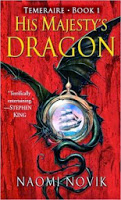
His Majesty’s Dragon by Naomi Novik: Book Review

His Majesty's Dragon begins when Captain Will Laurence's ship has just overpowered a French ship. Napoleon is slowly conquering Europe, so any defeat of the French, no matter how small, is a big deal. As Will's crew is inventorying the French ship's cargo, they find something unusual: a dragon egg. But complications arise when they find out that the egg will hatch in a week and they're about three weeks from shore. Dragons have been tamed in this alternate world and they're used to wreak devastation on the enemy. But they must imprint on their rider within the first few minutes of hatching if they're to be put to harness. That means someone from the ship's crew must step forward and be willing to sacrifice his naval career for the good of England. What a hugely fun fantasy/adventure! There's honestly no ground-breaking literature here, but if you want a good, swashbuckling adventure tale, this is it. I loved the dragon, Temeraire. He was by far the best character overall. It was fun to watch Will grow from being this stick in the mud British sea captain to finally loosening up some and having fun. Somewhat related to that, I loved the very proper British English present throughout the book. I have no idea how accurate is, except that the author is American which probably means it isn't, but sentences like, "Celeritas tells me to ask you to show me about; will you be so good?" just tickled me for some reason. I could just hear the very plummy uppercrust British guys talking. I don't really read military books, and this did sort of cross over to that genre. But the battle scenes were well-written and exciting. I didn't have any problem following what was going on. I did have a…

Life After Life by Kate Atkinson: Book Review

Ursula Todd is born on a cold winter's night in England in 1910...over and over again. Sometimes she is stillborn, other times she makes it through, only to die later and start over at the same place. Each time, something is a little different and her life takes drastically diverging paths as a result. Someone asked me what this is about and it's almost impossible to explain. "Reincarnation but...not. She lives the same life over and over but...not really." What matters is watching how minute differences in Ursula's life change her story completely. That was what I really enjoyed. I liked the whole concept of playing with a character's life like that just to see what happens. There were lives that I hated and lives that I loved. Some were depressing, some were horrific, some were odd, but they were almost all interesting. Some got a little crazy. The prelude shows us Ursula, a pretty English girl, setting out to assassinate--a Nazi official (I'm pretty sure it's not spelled out at that point). Where the heck did that come from? Once I got to that life, it did make sense but still--wow. There were a couple of drawbacks though. The book got repetitive. I don't think there was any possible way to avoid that in this kind of story but there you go. I think the author did the best anyone could have but I was still heartily sick of that snowy winter night that Ursula was born. Also, I started having trouble remembering what had happened in each life by the end. "Is this the one where this happened or was it that?" I can't say that I was always entirely sure. The characters weren't a huge draw for me but this is one instance where the story itself…

More Than You Know by Beth Gutcheon: Book Review

Hannah Gray is now an old woman, reliving the summer when she was seventeen and in love. She's revisiting her grandparents' house on the coast of Maine and re-reading her journal from that summer. She was fighting with her stepmother, her father was back home in Boston, and the house they had rented was haunted but Hannah was the only one who could see that. She eventually stumbles on the tale of a gruesome murder with ties to the house when it was located on an island out on the bay. In a dual narrative, the book contains Hannah's journal and relates the events surrounding the murder. I really just grabbed this out of a box of books that I borrowed from my aunt a long time ago and haven't finished reading. I glanced at the back and saw something about Maine and decided that sounded good to me. I was surprised to get a murder and a ghost! Don't get the idea that this is a horror novel. There's a lot more going on here than that. The ghost seems to serve more as an illustration of the ways we hurt each other in countless ways, both big and small, and the way that bitterness and anger cause effects that ripple out from us and down through generations. I liked Hannah and thought her parts captured that feeling of being young and in love and knowing that the world is too small to contain everything you feel. She just wants to do what she wants but she has her stepmother constantly trying to clip her wings. And Conary, the boy she loves--he's fabulous. I got the feeling that he could be a heart breaker but he's tender and caring and charming and almost perfect with Hannah. The story about…

Sovereign by C. J. Sansom: Book Review

Matthew Shardlake has been summoned by Archbishop Cranmer to assist with some law work as King Henry makes a royal progress through the rebellious north. He must also try to keep a prisoner alive for later questioning. But conspiracies still abound in the area and Shardlake's life is endangered when he stumbles onto something. Reading this felt like slogging through the mud created by the never-ending rain in the book. It just dragged on and on and on. Finally, in about the last hundred pages, the action picked up and everything started to get interesting. I enjoyed reading more about Shardlake and Barak, but overall, I have a lot of problems with the book. There were a lot of typos that drove me crazy. The Bealknap case (remember that from Dark Fire?) is still. dragging. on. C'mon and let it die already! With Shardlake being in the barbarous north, he obviously doesn't really understand the dialect. The explanation of some of the more common terms was unbelievably clumsy. One character basically says out of the blue, "Oh, by the way, old boy, did you know that gate means street up here?" Yes, it really was that bad. Reading this so soon after Ken Follett's The Pillars of the Earth was actually pretty interesting. In Pillars, we get to see how important the monasteries are and the hard work that goes into building a cathedral. In Sansom's books, the pendulum has swung the other way and they're being destroyed. I've never really thought too much about how much art, architecture, and history was lost in these kinds of purges, but the juxtaposition of the two books really brought that home for me. I'll keep reading, and if you've read the others, I would recommend you do the same. It was still…

The Sunday Wife by Cassandra King: Book Review

Dean Lynch is a Methodist preacher's wife, a role she finds nearly impossible to fill. She comes from a "white trash" background, to use her description, so saying the right thing at the right time and being peaches and cream in all situations just doesn't come naturally to her. When her husband is sent to minister in a church in Crystal Springs, Florida, Dean finally starts to find where she fits in. Unfortunately, that's not with all the catty church ladies. She befriends Augusta, a woman who left the church years ago, taking her husband, and more importantly, their money, with her. Augusta teaches Dean that life is too short to worry about what the church ladies are going to say. This is a tiny thing but it has irritated the heck out of me ever since I read it. At one point, Augusta's young son Gus goes to visit family in Chapel Hill, NC over Christmas. He's thrilled because he'll get to see snow. And then I think snow is mentioned again in Chapel Hill. And then Chapel Hill is referred to as being in the mountains. No. It's not. Nor can it be relied upon to get snow. It's pretty rare down there. Maybe it was supposed to be another town at first and everything in the book wasn't changed to mesh with reality. Whatever happened, this bugged me. Moving on! I did mostly enjoy the book. I liked Dean quite a bit. I wanted to shake her a few a lot of times and tell her to grow a backbone, but otherwise we got along just fine. She goes on and on about how terrible her marriage is and how her husband's a jerk, which he is, but a lot of times I was left thinking that…

Labyrinths by Jorge Luis Borges: Book Review

Um, I think I missed something. This book's average rating on GoodReads is 4.47 as I write this and I'm rating it 2 stars. Where did I go wrong? It's been a while since I finished so I won't be able to get too specific. First of all, I didn't particularly care for the writing style. Something about his writing reminded me of H. P. Lovecraft, who I also don't fully appreciate, so that was a negative. I found it to be a little...overwrought at times. I don't think it was the translation because there were many translators throughout the collection and the style was pretty consistent. And then I think Borges is just way too smart for me. I could see that there was all this philosophical stuff going on in the subtext of his writing, but I didn't care enough to stop and think about it and try to figure out what he was really saying. I was just trying to wrap my head around a world that was created in imagination and then starts to slowly creep into the real world. Or trying to determine which of two characters was the dreamer and which was the dreamed. Or were they the same? And why did this head injury leave this character with a Phenomenon-like memory and intelligence? And what the heck is the point of trying to see if you can perfectly re-write Don Quixote by accident? And if I lived in a never-ending library, would I seriously spend all my time searching for the one book with the answers to Life, the Universe, and Everything (Thanks, Douglas Adams) or would I just sit down with the books I had and leave others to the searching? I think my reaction to this book answers that last question.…

The Bite of the Mango by Mariatu Kamara: Book Review

Mariatu Kamara was twelve years old when she was caught up in the civil war in Sierra Leone. Most of her village was killed in a raid. Boy soldiers cut off both her hands but let her go. She shares the story of how she learned to cope in the new world she found herself in. Holy cow. I just can't imagine living through the things this young woman has experienced. And she was so young when everything happened! I just shudder to think of it. But she's a strong girl. She knows from the beginning that she must learn to live on her own. From the time she turns down the first helpful stranger's offer to feed her a bite of mango, she struggles to live her new life on her own terms. Her story is inspiring and heart-breaking and important. I know I as an American sometimes forget that most of the world doesn't have it as good as I do. I get caught up in the day-to-day of "I can't believe I have to deal with this at work," or "Traffic is a nightmare, I hate this commute," and forget that in some places in the world, children are killing and maiming each other in wars they don't understand. I for one need a reality check like this from time to time. Anyone who reads this should also read A Long Way Gone: Memoirs of a Boy Soldier by Ishmael Beah. Mariatu avoids demonizing the boy soldiers but it's still a good idea to get their perspective as well. They were also victims in this terrible conflict. This is by no means an easy read but I highly recommend it. Read an excerpt. Buy The Bite of the Mango at Malaprop’s | Better World Books I have…

Salt by Isabel Zuber: Book Review

Title: SaltAuthor: Isabel ZuberGenres: Historical Fiction, Southern LiteratureFormat: Paperback Synopsis: John Bayley meets Anna Stockton when she's in her late teens. He decides right away that he's going to marry her. She looks to be a strong woman who knows how to work. After burying two wives, that combination appeals to John. The rest of the book follows the ups and downs of their marriage and their relationship to the land. Review: My biggest issue with this book was that I somehow felt like I was watching a silent movie as I read it. I felt very much outside the story. I got the feeling that this was done on purpose so that I the reader would be more focused on what the author was trying to show me rather than on how I felt about each character or event. It was effective, but I do like to feel a connection to the characters I read about, so it wasn't a style I cared for. There was a lot going on in this book. The point didn't really seem to be the story itself, but rather to explore man's relationship to nature and also man's relationship to other men. What I took away was a message about humanity's need to dominate our surroundings and how futile that need is. Nature will win in the end. I also took away a message about the futility of our hopes and dreams and how we are ultimately so impermanent that we will be nothing more than a fleeting memory. This is all true, but it's a little bleak for my taste. The author is a poet and it shows in her lyrical, yet succinct prose. She says a lot in such a relatively short book, but she says it beautifully. Salt left me…