The Haunting of Andrew Sharpai by Jerome Peterson: Book Review

Andrew Sharpai has his heart broken when he's engaged to be married to a Vegas showgirl. He moves away from the bright lights and goes to Pocatello, Idaho. There, he meets Iris Winkle and her daughter, Lily. Rumor around town has it that Iris is a witch. With her horribly scarred face and her pentagram pendant, she doesn't do much to dispel the idea. Andrew is attracted to Iris though and finds himself in over his head when he starts to experience supernatural events. Do you ever read a book and think, "This is trying to tell me something, but I'm either not in a place to learn it now, or it's something I've already learned and moved past?" That's me with this book. I really liked Peterson's first book, Thumb Flagging, and liked what he had to say about learning from everyone you meet. Unfortunately, I don't feel like I learned anything from Andrew Sharpai. It could be the subject matter. Mention anything even slightly demonic and you have given me a big-time case of the heebie-jeebies. There wasn't enough going on to even give me nightmares, but I was a little worried when I realized where this was going. It is fairly tame stuff--the point isn't to scare the reader, I did get that much--but I didn't have any way of knowing that as I read. I did like the three main characters. Poor Andrew just wants someone to love and he keeps getting hurt. He's such a good guy though. Iris has lived a hard life, but she's learned from her mistakes and is now trying to move on and do the best she can. Little Lily stole the show. She's so funny and wise beyond her years, but she's so desperately trying to look out for…

Dear Jane Austen by Patrice Hannon: Book Review

Imagine, if you will, that Jane Austen can somehow receive letters from her modern-day readers, asking for her sage advice in love and marriage. That's the premise for this charming little book. Part "autobiography", part self-help book, and part critical analysis, Dear Jane Austen is full of practical advice for all women, no matter what era they're living in. Told in a tone that is mostly pitch-perfect, Austen weighs in on topics ranging from beauty to friends and family, to sex. The only thing that jarred was when she used modern phrases in her answers. There's something of an explanation included, but it still bothered me a little. There are some spoilers included if you haven't read Austen's entire body of work. I haven't yet, but this didn't really bother me. I think I'll have forgotten the little bits and pieces I learned by the time I actually get around to reading all of her other books. Fans of Austen will love this little book, especially the single women still looking for their Mr. Darcy. Review written April 18, 2009

The Vision of Emma Blau by Ursula Hegi: Book Review

Stefan Blau runs away from his home in Germany when he is a young man. He's always dreamed of living in America. He eventually finds himself in New Hampshire, building a beautiful apartment building, running a restaurant, and doing his best to provide for his family. Honestly, this book might have suffered from too many interruptions. My review is definitely suffering from allowing too much time to go by between finishing the book and reviewing it. I mostly enjoyed this, my problem was that I felt a little too distanced from the characters. An immigrant acclimating to America, German-Americans living through WWII, love, loss, family, strange neighbors--any of these should have made a book that I loved. The third-person narration felt so very distant from the action though that I just couldn't click with anyone. Also, this family is just desperately unhappy. The narration changes from Stefan to Helene to Robert to Emma and not one of them is happy. I just can't take that. The meaning of the title just dawned on me. I was understanding it as "Emma Blau's Vision," and it has a little to do with that, but mostly it's about "Stefan's Vision of Emma." If that had clicked earlier, I might have gotten a little more out of this. I kept waiting for Emma to show up and she didn't make her appearance until page 268. That's a lot of waiting. Once Emma did appear, she was actually my least favorite character. She's so very pushy and clingy, I felt a little smothered just reading about her. As an adult, she makes horrible choices in her life and doesn't really understand why she's unhappy. She's terrified of change and fights it however she can. She's one character in a line that takes care of the…

Crocodile on the Sandbank by Elizabeth Peters: Book Review

Miss Amelia Peabody is a confirmed spinster. Her father died and left her a comfortable inheritance and she has decided to start traveling to those ancient sites they both loved. She acquires the lovely yet troubled Evelyn as a companion in Rome and she sets off to visit Egypt. There, she meets the Emerson brothers. Younger brother Walter is a nice lad, but the older Emerson? Has a towering temper. The group accidentally fall in together and begin investigating some mysterious appearances around the Emersons' archaeological dig. I loved Amelia! In real life, I would probably chafe against her decisiveness and take-charge attitude, but safely on the page, she was great! She just ignores facts, people or attitudes that don't fit with what she's trying to do and goes about her business of leading everyone around. Fortunately, she's an intelligent woman, so her plans generally do work out for the best. Of course, she has a good heart under her tough exterior, and I was glad to see her friendship with Evelyn softening her up a little bit. I do love how she writes about Emerson. She calls him a big, hard-headed, stubborn bully every chance she gets, but when she gets close to him, she physically melts a little every time. She admits to it in her writing in moments of softness, then she goes on her merry way, arguing with him again. Emerson was great too. I didn't feel like I got to know him quite as well as I would have liked in this first book of a series, but he's a good match for Amelia. He's just as stubborn, but he's also passionate about archaeology and quietly yet fiercely loyal. Amelia exasperates him to no end, but he acknowledges her as an equal companion. The mystery…

Daughter of My People by James Kilgo: Book Review

Hart Bonner is the son of a formerly prosperous plantation owner. Jennie Grant is his cousin's biracial cook. In South Carolina in the early 1900s, she is considered a "Negro" and it is a felony for a white man to have "relations" with her. She and Hart carry on a secret affair for years though. The strain of the secret and outside influences take their toll on the relationship and things come to a head in 1918. White man, black woman, South Carolina, 1918. Can you say trouble? I rarely read synopses of books if someone recommends them to me, so I didn't know what I was getting into. When I figured out that this was the background of the story, my reading slowed to a crawl. It wasn't that the writing was bad or anything. I was just afraid to become attached to these characters when I knew that bad things had to be coming for them. In that place at that time, there would have been almost no limit to exactly how bad things could get. So I would read until I found myself caring for the characters, and then I would find something else to do. When I had gained a little distance again, I picked the book back up. This is not a good way for me to read and that's probably the biggest factor behind the three stars. This was so much more than just the obvious story. Looking inside this relationship was interesting and heartbreaking in an entirely different way than I had expected. Jennie and Hart truly love each other, but the secret meetings, the constant hiding and being careful, the sneaking out of Jennie's house before dawn inevitably take their toll. Hart would just put their love out in the open but…

Look Homeward, Angel by Thomas Wolfe: Book Review

I decided to read this because Thomas Wolfe was from my area and I only had to read one short story of his for an English class. I wanted to see what he was all about. This is basically the slightly fictionalized story of his childhood and young adult years growing up in the mountains of North Carolina in the early 1900's. I read the very first sentence of this book and my heart sank. So I read it again. And again. After about the fifth reading, I finally had some idea what he was trying to say and moved on. The second and third sentences blew me away. He was an amazing writer. He wrote with a richness of imagery that is hard to find. That being said, this book was very hard to get through. Taken a paragraph or so at a time, I could appreciate the beauty of his language. But the very beauty that I admired made the actual story drag by. And I'm very story-oriented. That's one of the reasons I only gave this three stars. The other thing that bothered me was a small vein of racism that was present throughout the book. It's not at all the point of the story, it's just there in the background. And somehow it's made worse by the fact that there doesn't seem to be any active dislike behind it. It feels like he thinks he's just stating the facts. I tried to write it off as just being a different time period, but that didn't really work for me. It wound up detracting a lot from my enjoyment of the book. But if you think you can overlook that, and you love beautiful language, you might enjoy this one.

A Short History of Nearly Everything by Bill Bryson: Book Review

Bill Bryson is back and this time's he's tackling the question of "Where do we come from?" in a very accessible kind of way. He gives an everyman's scientific explanation of the creation of the universe, the world, the atmosphere, evolution, human evolution, you name it. Pretty much all the sciences are covered, from astronomy to physics to geology to biology and plenty more that I can't think of at the moment. I'm not really a non-fiction person. I'm just not. But Bill Bryson usually keeps me entertained with his witty writing style. He didn't really manage to be witty while writing about science, but he was interesting. Probably some of my favorite parts were back stories about how odd some of the most famous scientists were (Did you know that Sir Isaac Newton, probably one of the most brilliant scientists that has ever or will ever live, decided to shove a big needle into the back of his eye one time, just to see what would happen?). I also got my biology degree once upon a time, so he did get around to covering stuff that does obviously interest me. There was absolutely no mention of creationism in this book, so I wouldn't recommend it to people who would be offended by that. He did get a little environmentally preachy right at the very end, but that didn't bother me. If you're interested in how things work--or, sometimes, just how scientists think things might work--this book is for you.

Stardust by Neil Gaiman: Book Review

Synopsis from GoodReads: Stardust is an utterly charming fairy tale in the tradition of The Princess Bride and The Neverending Story. Neil Gaiman, creator of the darkly elegant Sandman comics and author of The Day I Swapped My Dad for Two Goldfish, tells the story of young Tristran Thorn and his adventures in the land of Faerie. One fateful night, Tristran promises his beloved that he will retrieve a fallen star for her from beyond the Wall that stands between their rural English town (called, appropriately, Wall) and the Faerie realm. No one ever ventures beyond the Wall except to attend an enchanted flea market that is held every nine years (and during which, unbeknownst to him, Tristran was conceived). But Tristran bravely sets out to fetch the fallen star and thus win the hand of his love. His adventures in the magical land will keep you turning pages as fast as you can--he and the star escape evil old witches, deadly clutching trees, goblin press-gangs, and the scheming sons of the dead Lord of Stormhold. The story is by turns thrillingly scary and very funny. You'll love goofy, earnest Tristran and the talking animals, gnomes, magic trees, and other irresistible denizens of Faerie that he encounters in his travels. Stardust is a perfect read-aloud book, a brand-new fairy tale you'll want to share with a kid, or maybe hoard for yourself. (If you read it to kids, watch out for a couple of spicy sex bits and one epithet.) --Therese Littleton I'm pretty sure this is the first book of Gaiman's that I read. I read the novel but I need to get the graphic novel sometime. I have Charles Vess's Drawing Down the Moon, which features quite a few panels from the Stardust graphic novel, and it's beautiful.…

Serena by Ron Rash: Book Review

In Depression-era North Carolina, a timber baron marries Serena and brings her to the lumber camps to live. Her ambition outmatches his and she drives him to succeed, prosper, and expand at any cost. Wow. What a character Ron Rash has created in Serena. I detested her, but she is going to stick with me the way Lady MacBeth and Medea have. I had to admire her strength and ambition, but she was ruthless and proud of it. She seemed to see those weaker than her as prey, and she saw almost everyone as being weaker than her. There's a kind of mythology that springs up around her in the camp. She thinks of ingenious solutions to problems, such as rattlesnake bites among the loggers. She really doesn't care when loggers die though. It's the Depression after all, and for every one worker that dies or is disfigured, there are innumerable men waiting to take his place. I would have liked an explanation as to why she was the way she was. She grew up in the camps, and there's a dark past that's hinted at but never explained. Was she just born heartless or did something or someone shape her to be that way? This book takes place practically in my backyard, and I had heard that these mountains were devastated back in the day. It's one thing to just kind of know that, and it's another to live it for two years inside a book. This one fictional camp ended in the clear-cutting of 34,000 acres. I can't even wrap my mind around that much land. I had to go Google some pictures. Look at these. Mount Mitchell, the highest peak east of the Mississipi Photo taken by Bms4880 and found on Wikimedia Commons Mount Mitchell in 1923…

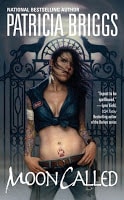
Moon Called by Patricia Briggs: Book Review

Mercy Thompson is a walker. Not that kind of walker. A "skinwalker." She can shift into coyote form easily and at will. Her sexy neighbor is the Alpha of the local werewolf pack. She's good friends with a vampire. Her life isn't exactly normal. When a new lone werewolf shows up at her garage one day looking for work, trouble follows him to Mercy's doorstep. Mercy has to figure out what's going on before her friends and family get hurt. I loved this! Mercy is a great character. She's smart, loyal, caring, funny, and sarcastic. She can hold her own against all the Alpha men in her life. And, oh those Alpha men.... There were a lot of men to choose from here. Adam is the ex-military guy who sticks his nose into Mercy's business whether she wants him to or not. There's a lot of history between Samuel and Mercy. Warren is loyal to his pack and the rules at any cost. There are actually more, if you can believe that. I don't know why I liked all these guys so much; I generally can't stand overly-dominant men in person. But these guys didn't just see themselves as powerful. With their power came responsibility to those weaker than themselves, and they took that responsibility seriously. That must be the difference for me. Briggs filled in the details of this world pretty smoothly. I never felt like I was just getting an info dump. A couple of times Mercy explained to a werewolf something like how the werewolves would defeat the vampires in a battle and I was pulled out of the story enough to think, "Honey, he knows that. Oh. That was for my benefit." And then I moved on. I know that I'm probably in the minority here,…