Mockingjay by Suzanne Collins: Book Review

If you haven't read The Hunger Games and Catching Fire, you shouldn't read this review. I have avoided Mockingjay spoilers. Katniss is living in District 13. The Capitol has sought revenge for the rebels' assault on the Hunger Games in a brutal, unbelievable way. The rebellion is gaining momentum, and the leaders are begging Katniss to become their figurehead--the living Mockingjay. This was still good, it just wasn't exactly what I expected, and I think the biggest reason I say that is because of Katniss. I felt like I'd lost her. She's so heartsick. She feels responsibility for so many deaths. She spends a large part of the book wandering around lost. There are flares of the Katniss that I love, but they aren't consistently there. Do I buy her reaction? Absolutely. Am I happy about it? Obviously not. Katniss's fire is what has drawn me to these books, and she's down to embers. Otherwise, the book twisted and turned and I had no idea what to expect or who to trust. I was thrilled to get to see more of Gale. I've always felt like he hasn't had a fair chance with Katniss, and he does get his chance here. There are so many losses, my heart just broke over and over again. There were losses in Catching Fire that I still hadn't reconciled myself to, so these new ones just felt terrible. That should say something about how lost I get in this world, shouldn't it? I'm still mourning. I still love the series, I still recommend it, I just want fiery Katniss back. Buy Mockingjay on IndieBound | Book Depository | Better World Books I have an affiliate relationship with IndieBound, Book Depository, and Better World Books and will receive a small commission at no cost to…

Into Thin Air by Jon Krakauer: Book Review

In 1996, Jon Krakauer attempted to climb Mt. Everest as part of a guided group for a writing assignment for Outside magazine. An experienced climber in the hands of a reputable group of guides, he didn't really foresee any problems. Go, climb the mountain, hope conditions allowed them to reach the summit, go home, write the article. But things are rarely that easy. A storm blows up, reminding everyone that nature laughs at our best-laid plans; some questionable decisions are made; and suddenly the entire group is fighting for their lives. I've decided to try reading a non-fiction book in bed at night, thinking that I won't be quite as interested in non-fiction, and so will find it easy to put those books down and get to bed at a decent hour. This is the first book I grabbed from the library with that in mind. Ha! I don't know if I could have picked a worse book for tame, before-bed reading! My poor husband has had to listen to me babble on and on about people he knows nothing about as I've made my way through this page-turner. Even if the climb had been fairly straight-forward, I found it interesting to read about what drove these people, how they acclimated to the altitude, and how exactly one manages to climb the highest peak on Earth. I know nothing about mountain-climbing, and, while I did find all this fascinating, I have to say that I'll be staying in my tame little Appalachians doing easy to moderate hikes. I'm not someone who likes to push myself beyond my limits, but it's always nice to step outside your comfort zone, even if it is through the pages of a book, and see what's going on with others who live differently than you.…

The Christmas Box by Richard Paul Evans: Book Review

The Christmas Box is about a young couple and their young daughter who move in with an elderly widow to help her out with light chores in exchange for rooms. Mary, the widow, becomes an adopted grandmother to them all and feels compelled to pass on wisdom she has gained with her years. This was a nice, easy read (I literally read it in about an hour). The lightness of the story, though, masks the underlying lesson about the first gift of Christmas and the preciousness of time. I would recommend this to anyone, but especially busy parents who are maybe starting to lose sight of what really matters to their children. Reviewed December 6, 2007

Spilling the Beans on the Cat’s Pajamas by Judy Parkinson: Book Review

Have you ever wondered exactly where some of our more common phrases come from? Judy Parkinson sets out to give a brief definition and history of some colorful, common English sayings. I found this book interesting and I learned a lot. For example, "Put a sock in it!" comes from the days of the old gramophones. They didn't have volume controls, so to turn the record player down, owners would put a sock inside the bell the sound emerged from. While I did enjoy learning the meaning behind some of these sayings, I have to say that the definitions were a bit dry. Take this definition of "shoot the moon": "This is an expression meaning to leave without paying one's bills or rent, or to remove swiftly one's household goods under cover of night to avoid their seizure by a landlord or creditor." This seemed like a good place to have a little fun or lighten the tone, but instead it felt more like a scholarly work. This is a short little book at 169 pages, so I wasn't expecting the scholarly tone. This is an interesting look at some of the origins of our language, and I recommend it for those curious about such things. Christmas is coming up, and I think this would make a good stocking stuffer if you have any lovers of language in your life. Thanks to FSB Media for sending me a copy for review.

The Ice Soldier by Paul Watkins: Book Review

William Bromley is a World War II veteran living in 1950's London. In the war, he led a mountaineering expedition that ended disastrously. He has never moved past this and started living again. He's just existing--teaching school, admiring the secretary from a distance, spending Friday evenings with his one friend, and visiting his father on school breaks. There's nothing exciting in his life and that's the way he likes it. Notably, he has also completely given up mountain climbing. Then something changes and he is left wondering if his life is really enough and does he have the courage to start truly living his life again? I enjoyed this. The story itself was very well-written and easy to read. The pacing was good and the way that things were slowly explained really worked. Probably the best part was that within this very straightforward story, the author manages to explore big themes like man vs. nature, the nature of friendship among men, and what war can still do to those lucky enough to survive. In other words, it works on many levels. If you want a simple adventure story, that's in here. If you want something to chew over and think about for a while, that's in here too. Reviewed June 21, 2008

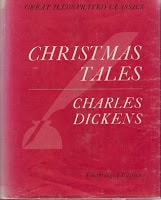
Christmas Tales by Charles Dickens: Book Review

I read this for A Christmas Carol but decided to read the rest and see what else Dickens had to say about Christmas. There were a few other little gems, although none were as good as A Christmas Carol, but there were some that I didn't like at all. A Christmas Carol was a 4 star book for me. It was entertaining, Dickens made his point pretty quickly, and it was actually kind of funny. That surprised me. I loved this part: "Old Marley was as dead as a door-nail. Mind! I don't mean to say that I know, of my own knowledge, what there is particularly dead about a door-nail. I might have been inclined, myself, to regard a coffin-nail as the deadest piece of inronmongery in the trade. But the wisdom of our ancestors is in the simile; and my unhallowed hands shall not disturb it, or the Country's done for. You will therefore permit me to repeat, emphatically, that Marley was as dead as a door-nail." I'm glad I read this, but at the same time, I can't help but feel that if you've seen one of the many, many movies, you know what the book is about. There is very little in the book that doesn't make it into the movies. Read it if you're curious, but don't feel you're missing out on anything if you don't. "The Chimes"--2 stars--This was similar to A Christmas Carol, but this time a poor man is shown how much worse the world could be. There aren't any little flashes of humor, the book got very preachy, it was too melodramatic, and I was left wondering why Trotty, the main character, is going through all this when he's surrounded by rich jerks who really need to be taught a lesson.…

The Classics by Caroline Taggart: Book Review

Do you ever find yourself reading along, and when you come to a reference to ancient Greece or Rome, you start scratching your head? With sort of a, "I think I heard something about that somewhere, but I don't remember much about it" kind of thought? The Classics:  All You Need to Know, from Zeus's Throne to the Fall of Rome is the book for you. Caroline Taggart has put together a short (169 pages) primer/refresher for all that ancient stuff that you used to know but that has fallen by the wayside. Or maybe you never learned it in the first place. For such a short book, Taggart has packed a surprising amount of information into it. Topics covered include language, mythology, philosophy, history, the arts, the sciences, and a few more things. You won't read the book and be an expert by any means, but you will certainly have a decent base of knowledge to work from. The book might sound boring, but Taggart's style is actually pretty fun. "Atlas was inhospitable to Perseus (see page 47), who used the head of Medusa to turn him into a mountain range in North Africa, which takes almost as much talent as cutting someone's head off while looking at their reflection in a shield, and makes me think that Perseus could have taught David Copperfield a thing or two." She also occasionally mentions modern-day references to these ancient stories. "The first famous figure to emerge from this was Draco, who has given his name to very harsh measures in any context, as well as to a character in Harry Potter who provokes the audience to hiss whenever he appears." It's very good for what it is, but after suffering through a 10th-grade English teacher who seemed to think that World…

The Somnambulist by Jonathan Barnes: Book Review

The Somnambulist features Edward Moon, a conjurer most easily compared to Sherlock Holmes, but with a freakish twist. His Watson is an 8-foot-tall mute man named--can you guess?--The Somnambulist. The pair are asked to investigate a bizarre murder in the seamier part of London at the beginning of the novel. Within pages, they have solved the murder. Or have they? This was a quick, enjoyable read. The characters may have seemed a little like stock characters at first, but they almost always turned out to be something other than they appeared. The plot was well-paced and, for me anyway, the mystery was pretty unpredictable. But, be warned. I picked this up thinking that it might be like The Alienist but set in London with a few sideshow freaks. It starts out that way, but by the end, the book wanders into solid fantasy. That wasn't a problem for me because I am a huge fan of fantasy, but I know that's not the case for a lot of mystery fans. But it did go a little over the top for me, which is part of why it's 3.5 stars instead of 4.5. Also, I was left with a lot of unanswered questions. I like to have everything pretty tidily resolved at the end. I can't even figure out why the book is titled The Somnambulist instead of The Conjurer except that it sounds cooler. If nothing else, read the first chapter of this book. It's only about a page long. Read it while you're browsing the bookstore or the library. This was the best first chapter I've read in a long time. Here's the first paragraph: "Be warned. This book has no literary merit whatsoever. It is a lurid piece of nonsense, convoluted, implausible, peopled by unconvincing characters, written in…

The Girl Who Kicked the Hornet’s Nest by Stieg Larsson: Book Review

In the interest of avoiding spoilers for the second book, I'll just say that this picks up immediately after that awful cliffhanger of an ending in The Girl Who Played With Fire. So much has been said that I don't feel like I have a whole lot more to contribute. I (mostly) raced through the book, frantic to find out how big this conspiracy was, how far they would go, whether or not they would finally get caught, and how it would all go down. Salander wasn't quite as large a figure in this one, for obvious reasons if you've been reading the trilogy, so I missed her. She was still the same old inscrutable, fascinating Salander in the parts she was in. She's growing though. I wish Larsson had been able to write more books about her so we could see how she ultimately turns out. Three things bothered me. One was the setup of Salander's initial location. Vague enough? That would never happen here in the US. Not where I work anyway. Can you say armed guards (at the least) and different floors? So I'm left wondering if Larsson took an easy way out to steer the book where he wanted it to go or if Sweden is that different. Surely not. At the very beginning, there's a whole lot of telling and not much showing. We're told what Blomqvist and the police got up to in the few hours immediately after the end of the second book. Why not just write that part as actual scenes happening in real time? It probably wouldn't have taken up much more space and there was certainly enough happening to have kept my attention. I have had a problem with the amount of detail Larsson includes throughout the entire series. This…

The Red Umbrella by Christina Diaz Gonzalez: Book Review

Lucía Álvarez is your typical teenage girl. She has a crush on cute Manuel, she and her best friend Ivette are interested in all the latest fashions and movies, and she's trying to fit in at school. So when Fidel Castro cancels classes, her only thought is enjoying her unexpected freedom. She slowly realizes how dangerous things are becoming in her country. Finally, her parents break the news that Lucía and her younger brother Frankie are being sent to America, where they don't know anyone, all alone. My father-in-law is Cuban and he was about Lucía's age when he left Cuba on one of the so-called Pedro Pan flights. He was fortunate to have family waiting for him in America. Because of him, I am fascinated by this country's history. To think that my father-in-law lived through a revolution and is part of a community that still in large part considers themselves to be exiles 50 years later. It just blows my mind. So when I came across this book, I knew I had to read it. I loved it. It works precisely because Lucía is the girl next door. There's nothing that really stands out about her, and I don't mean that in a bad way at all. She's a nice girl just trying to grow up and worrying about her first dance. Most of us can probably relate. As the revolution insidiously intrudes on her life, she is horrified and terrified. She sees things that no 14-year-old girl should see. And then she's in America alone with her seven-year-old brother. She speaks very little English and doesn't know anyone. So now there's the immigrant experience as she learns about a new culture and new people and tries her best to fit in at a new school. And she's…