A Short History of Nearly Everything by Bill Bryson: Book Review

Bill Bryson is back and this time's he's tackling the question of "Where do we come from?" in a very accessible kind of way. He gives an everyman's scientific explanation of the creation of the universe, the world, the atmosphere, evolution, human evolution, you name it. Pretty much all the sciences are covered, from astronomy to physics to geology to biology and plenty more that I can't think of at the moment. I'm not really a non-fiction person. I'm just not. But Bill Bryson usually keeps me entertained with his witty writing style. He didn't really manage to be witty while writing about science, but he was interesting. Probably some of my favorite parts were back stories about how odd some of the most famous scientists were (Did you know that Sir Isaac Newton, probably one of the most brilliant scientists that has ever or will ever live, decided to shove a big needle into the back of his eye one time, just to see what would happen?). I also got my biology degree once upon a time, so he did get around to covering stuff that does obviously interest me. There was absolutely no mention of creationism in this book, so I wouldn't recommend it to people who would be offended by that. He did get a little environmentally preachy right at the very end, but that didn't bother me. If you're interested in how things work--or, sometimes, just how scientists think things might work--this book is for you.

Cleopatra’s Daughter by Michelle Moran: Book Review

When Cleopatra and Marc Antony are defeated by Octavian, their children are taken to Rome, where Octavian can make sure they don't become rallying points for those who might oppose his rule. Their daughter Selene is never happy in Rome and constantly looks for ways to win her family's way back home. This book jumps right into the action as Octavian conquers Alexandria and thus Egypt. It grabbed my attention right away and held it until I finished. I really enjoyed the way that Moran brought these historical figures from so long ago into such a vibrant reality for me. I even cared about (or hated, as the case may be) the minor people from history that I hadn't heard of before. Selene herself is just a great character. She's smart, strong, independent, loyal, free-thinking, and far from perfect. Who likes perfect characters anyway? She acts without thinking sometimes and gets herself in trouble. I did occasionally get confused by the names. There were Octavian/Octavia and Antonia/Tonia. In the author notes, Moran said she actually changed some of the names to make it less confusing. I guess Octavian and Octavia are so famous that she didn’t feel like she could change them, but I frequently had to stop and try to remember which one was the emperor and which one was his sister. I know people got married younger and didn’t live half as long as we do now, but these kids felt entirely too old. Selene and Alexander are supposed to be 11-15 years old when this takes place, but they honestly felt about a decade older to me. Moran addressed this in her Afterword, saying that they had been so highly educated and trained to rule practically from birth that they would feel precocious to us. I can…

Bite Me by Christopher Moore: Book Review

I don't think I can even begin to explain the appeal of these books. A synopsis is going to make it sound ridiculous. A giant shaved vampire cat named Chet is stalking the San Francisco night? Puh-leeze. Except that leaves out Abby Normal, Emergency Backup Mistress of the Greater Bay Area Night. I. ♥ This. Chick. Abby is hilarious! I loved her in You Suck: A Love Story and I was thrilled when I found out that she tells most of this newest story. She makes grown men cry. She intimidates the hell out of Foo-Dog, her manga-haired love monkey. I mean, she wears Skankenstein boots. What more do you need to know? There are vampire cats, rats, and birds; a Samurai-sword-wielding old guy; UV-light jackets and dusters; UV, um, bazookas? that rack up serious points in the vampire elimination game; vampires climbing face first down walls a la Dracula; a fortune-teller who actually gets it right but doesn't understand any of it; a sea captain named Kona who speaks like a Rasta; truly crazy vampires; and overseeing it all is The Emperor of San Francisco, protector of Alcatraz, Sausalito, and Treasure Island and his two loyal men, Bummer and Lazarus. Sound over the top? It is. But it's so much fun. So take note beyotches. There will be a test. Yes, that's pretty much a quote. If it offended you, steer clear because this won't be the book for you. The f-bomb abounds.

Thumb Flagging by Jerome Peterson: Book Review

Willy is a seasoned hitchhiker who introduces Jay to the wonders of the open road in order to boost his self-confidence and rid him of his spoiled-Catholic-boy tendencies. I enjoyed this. As you can imagine in a book about hitchhiking, it's a bit of a picaresque novel with stories about the other hitchers and rides they catch. There were some interesting stories, some crazy stories, and some unexpected stories. Some of the people whom I stereotyped based on their descriptions had surprising insights or tragedies to share. Jay finally realizes that everyone he meets has something to teach him and he starts to actively think about it and seek out the lessons. I like it. I did enjoy the second half a little more, when Chloe was introduced. She was a great character! Tough, vulnerable, funny, she just brightened up the book for me. And Nanook! If I had a dog, I would want her to be just like Nanook, one of the best dogs ever. This really could just be read as a story of two young men hitchhiking around the country and the characters they meet, but there's more to be learned than that. Jay identifies his weaknesses and learns to try to grow past them, recognize them when they show back up, and keep fighting those tendencies. Willy learns that you can't just ignore your problems; you have to face them or they'll lead to even bigger problems down the road. They both learn to appreciate good traveling companions while you have them, but gracefully let them go when it's time to move on. There were a couple of plot lines that were left unresolved, so I'm wondering if there will be a sequel. The book feels pretty complete on its own, but if there is a…

Stardust by Neil Gaiman: Book Review

Synopsis from GoodReads: Stardust is an utterly charming fairy tale in the tradition of The Princess Bride and The Neverending Story. Neil Gaiman, creator of the darkly elegant Sandman comics and author of The Day I Swapped My Dad for Two Goldfish, tells the story of young Tristran Thorn and his adventures in the land of Faerie. One fateful night, Tristran promises his beloved that he will retrieve a fallen star for her from beyond the Wall that stands between their rural English town (called, appropriately, Wall) and the Faerie realm. No one ever ventures beyond the Wall except to attend an enchanted flea market that is held every nine years (and during which, unbeknownst to him, Tristran was conceived). But Tristran bravely sets out to fetch the fallen star and thus win the hand of his love. His adventures in the magical land will keep you turning pages as fast as you can--he and the star escape evil old witches, deadly clutching trees, goblin press-gangs, and the scheming sons of the dead Lord of Stormhold. The story is by turns thrillingly scary and very funny. You'll love goofy, earnest Tristran and the talking animals, gnomes, magic trees, and other irresistible denizens of Faerie that he encounters in his travels. Stardust is a perfect read-aloud book, a brand-new fairy tale you'll want to share with a kid, or maybe hoard for yourself. (If you read it to kids, watch out for a couple of spicy sex bits and one epithet.) --Therese Littleton I'm pretty sure this is the first book of Gaiman's that I read. I read the novel but I need to get the graphic novel sometime. I have Charles Vess's Drawing Down the Moon, which features quite a few panels from the Stardust graphic novel, and it's beautiful.…

Serena by Ron Rash: Book Review

In Depression-era North Carolina, a timber baron marries Serena and brings her to the lumber camps to live. Her ambition outmatches his and she drives him to succeed, prosper, and expand at any cost. Wow. What a character Ron Rash has created in Serena. I detested her, but she is going to stick with me the way Lady MacBeth and Medea have. I had to admire her strength and ambition, but she was ruthless and proud of it. She seemed to see those weaker than her as prey, and she saw almost everyone as being weaker than her. There's a kind of mythology that springs up around her in the camp. She thinks of ingenious solutions to problems, such as rattlesnake bites among the loggers. She really doesn't care when loggers die though. It's the Depression after all, and for every one worker that dies or is disfigured, there are innumerable men waiting to take his place. I would have liked an explanation as to why she was the way she was. She grew up in the camps, and there's a dark past that's hinted at but never explained. Was she just born heartless or did something or someone shape her to be that way? This book takes place practically in my backyard, and I had heard that these mountains were devastated back in the day. It's one thing to just kind of know that, and it's another to live it for two years inside a book. This one fictional camp ended in the clear-cutting of 34,000 acres. I can't even wrap my mind around that much land. I had to go Google some pictures. Look at these. Mount Mitchell, the highest peak east of the Mississipi Photo taken by Bms4880 and found on Wikimedia Commons Mount Mitchell in 1923…

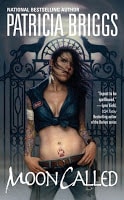
Moon Called by Patricia Briggs: Book Review

Mercy Thompson is a walker. Not that kind of walker. A "skinwalker." She can shift into coyote form easily and at will. Her sexy neighbor is the Alpha of the local werewolf pack. She's good friends with a vampire. Her life isn't exactly normal. When a new lone werewolf shows up at her garage one day looking for work, trouble follows him to Mercy's doorstep. Mercy has to figure out what's going on before her friends and family get hurt. I loved this! Mercy is a great character. She's smart, loyal, caring, funny, and sarcastic. She can hold her own against all the Alpha men in her life. And, oh those Alpha men.... There were a lot of men to choose from here. Adam is the ex-military guy who sticks his nose into Mercy's business whether she wants him to or not. There's a lot of history between Samuel and Mercy. Warren is loyal to his pack and the rules at any cost. There are actually more, if you can believe that. I don't know why I liked all these guys so much; I generally can't stand overly-dominant men in person. But these guys didn't just see themselves as powerful. With their power came responsibility to those weaker than themselves, and they took that responsibility seriously. That must be the difference for me. Briggs filled in the details of this world pretty smoothly. I never felt like I was just getting an info dump. A couple of times Mercy explained to a werewolf something like how the werewolves would defeat the vampires in a battle and I was pulled out of the story enough to think, "Honey, he knows that. Oh. That was for my benefit." And then I moved on. I know that I'm probably in the minority here,…

The Girl Who Chased The Moon by Sarah Addison Allen: Book Review

3.5 Stars. I really liked the whole story, I just felt that I wanted a little more meat to it. That's really my only criticism. I liked the way that Emily learned the value of family. Julia learns that for most people, home will always be home, no matter how hard you try to leave it behind. I loved the way that the Coffeys [...]

People of the Sword by Neil O’Donnell: Book Review

The powerful wizard Crarnock has decided to wipe out humanity with the combination of his magic and his goblin hordes. In order to mount a resistance, the people opposing him must put aside their prejudices, band together and work as one. My huge problem was that this needed a lot more editing. I'm not talking about just a few typos here and there, I'm talking about lots of typos, incorrect word usage that spell checker will always miss, characters saying gonna when their speech has otherwise been very formal, formatting mistakes, and more. It could also have used a general tightening up of the story line. I did read a finished copy, not an ARC. I would have had a hard time overlooking all of this even if it had been an ARC. There were about three gigantic info dumps. I will say that O'Donnell has obviously spent a lot of time thinking about this world he's created, from the history and mythology right down to the smallest details, but my eyes glazed over as I read about the religious history and shifting power between the knights and druids. One character was supposed to be telling another the history, but when that one character talks for pages and pages, I have to call it an info dump. The story itself was okay. I couldn't help but compare it to The Lord of the Rings. I don't want to go into that too much and give anything away, but I think even from my brief synopsis you can see that there's going to be a little similarity. There was a lot of similarity in the overall arc of the story, but the details were different, if that makes any sense. I honestly never managed to finish The Lord of the Rings,…

Night by Elie Wiesel: Book Review

Honestly, I can't help but feel that for me to sit in judgment of a memoir of the Holocaust would be terribly presumptuous. We can't ever forget the Holocaust, and any work that reminds us of what happened is important and should be read as widely as possible. The style is a little sparse for me, but do we really need lavish descriptions of crematoriums? I didn't think so. What is important is that Wiesel laid out his thoughts and feelings for all the world to see, an act of unimaginable courage. It is amazing to me how quickly he and the other prisoners were stripped of their very humanity. It is also amazing how tiny acts of kindness stand out in his memory. But we all know those were too few and far between. Just read this. Today, April 11, 2010, is Holocaust Remembrance Day. Six million Jews were killed in WWII.  Six million. How do we even begin to wrap our minds around that kind of loss? It's as if everyone in the cities of Los Angeles and Chicago were gone. No longer there. Because of violence and ignorance and prejudice. We cannot forget the loss of these people.  The Jewish people are the chief mourners, but we should all mourn their loss.  The victims weren't "only" Jews, they were citizens of the world.  My world.  Your world. Our world. Who knows how things might be different now if such a staggering loss hadn't occurred then? Read Elie Wiesel's 1986 Nobel Peace Prize acceptance speech. Visit the US Holocaust Museum's Days of Remembrance page. Visit the US Holocaust Museum's Holocaust Encyclopedia. Here are links to other books I've read, both fiction and non-fiction, that focus on the Holocaust. Maus I: A Survivor's Tale: My Father Bleeds HistoryMaus II:…