The Gendarme by Mark Mustian: Book Review

Emmett Conn is 92 years old and he has started having seizures and disturbing dreams/flashbacks. His early years are a mystery to him anyway. He awoke in a British hospital in WWI, a Turkish soldier mistakenly picked up after he was severely wounded. That's as far back as he can remember. But now in his dreams he seems to be re-living a past where he was a soldier in charge of a group of Armenian people in what later came to be known as the Armenian genocide. Are these real memories? And what of the beautiful girl with different-colored eyes? Was she real and did he love her? I feel like this is a very literary book and I should have something very smart and literary to say, but that's just not my style. I can only tell you what I liked and didn't like. I had never even heard of the Armenian genocide until sometime in the past year or two. It was actually a passing reference on GoodReads. I left it at that. I'm disappointed in myself. I'll be the first to spout off with how we have to remember the Holocaust so we don't repeat history, but I didn't bother to at least look at Wikipedia and see what happened to the Armenians. And they are in danger of being forgotten. I saw this author (who is of Armenian descent) speak at the Decatur Book Festival, and he said that Hitler, only about 20 years after all this happened, even said something like, "Who even remembers the Armenians?" Shameful. Anyway. This book is told from an aggressor's point of view. He personally didn't feel strongly one way or the other about the Armenians, he just wanted to join the army and fight in WWI. Before that could…

The Outer Banks House by Diann Ducharme: Book Review

Abby Sinclair is the neglected daughter of a plantation owner. Three years after the end of the Civil War, she is still mourning the loss of her uncle and her family is still adjusting to the loss of their slaves. When her father decides to move the whole family out to the Outer Banks of North Carolina for the summer, Abby is excited to see the ocean for the first time. Something about the wildness of the ocean stirs up a wildness that had almost been lost in herself. And then she meets "Banker" Benjamin Whimble, a dirty, uneducated young man who nevertheless has something to teach her. I loved the descriptions of the Outer Banks in the 1860s. It's hard to think of them as they are now, crowded with houses up to the water's edge in places, and read about how no one built close to the water in this time period because of the harshness of the storms. At the very beginning, Abby runs clear across Nags Head from the sound to the ocean, finding nothing but sand on the way. I'm thinking about the traffic, outlet malls and shops and restaurants, and the Wright Brothers Memorial that she would meet today. "Progress" is of course inevitable, but reading something like this makes me wonder if it's worth the cost. I liked watching Abby come into her own. The loss of her uncle, who was more truly her father than her father is, has left her reeling. She's withdrawn and bookish, and she's starting to be pushed around a little too much by her parents. She slowly and believably starts to regain her old confidence and to even make some surprising decisions for herself. I liked Benjamin a lot. He sees the world clearly through his intense…

Everything is Going to be Great by Rachel Shukert: Book Review

After college, Rachel Shukert ended up working for free for a well-known experimental theater director. The play took a brief tour of Europe, and Rachel was thrilled when she found out that her passport had not been stamped. That meant she could stay in Europe as long as she wanted without a visa, since no one officially knew she was there. Setting out to "find herself," she ends up living with two of her gay best friends in Amsterdam, jobless, but more than willing to try out the local booze and dating scene. I'm not the right reader for Everything is Going to be Great: An Underfunded and Overexposed European Grand Tour. Call me a prude if you want, but I somehow (thankfully) avoided the stage of life that Rachel Shukert describes in her memoir. I don't understand the appeal of drinking until you end up in the hospital, or waking up with a man you met for the first time the night before. So when I ran into both things within the first few pages of this memoir, I knew this wasn't going to be a book that I connected with. If you did go through this stage, perhaps you'll enjoy this memoir more than I did. It is funny, but, like I said, I just didn't really connect with what Rachel was going through inflicting on herself. The book is well-written, and I did end up cheering for Rachel in the end, but the lifestyle described in the pages is a turn-off for me. Thanks to Harper Perennial for sending me a copy for review.

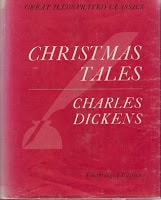
Christmas Tales by Charles Dickens: Book Review

I read this for A Christmas Carol but decided to read the rest and see what else Dickens had to say about Christmas. There were a few other little gems, although none were as good as A Christmas Carol, but there were some that I didn't like at all. A Christmas Carol was a 4 star book for me. It was entertaining, Dickens made his point pretty quickly, and it was actually kind of funny. That surprised me. I loved this part: "Old Marley was as dead as a door-nail. Mind! I don't mean to say that I know, of my own knowledge, what there is particularly dead about a door-nail. I might have been inclined, myself, to regard a coffin-nail as the deadest piece of inronmongery in the trade. But the wisdom of our ancestors is in the simile; and my unhallowed hands shall not disturb it, or the Country's done for. You will therefore permit me to repeat, emphatically, that Marley was as dead as a door-nail." I'm glad I read this, but at the same time, I can't help but feel that if you've seen one of the many, many movies, you know what the book is about. There is very little in the book that doesn't make it into the movies. Read it if you're curious, but don't feel you're missing out on anything if you don't. "The Chimes"--2 stars--This was similar to A Christmas Carol, but this time a poor man is shown how much worse the world could be. There aren't any little flashes of humor, the book got very preachy, it was too melodramatic, and I was left wondering why Trotty, the main character, is going through all this when he's surrounded by rich jerks who really need to be taught a lesson.…

Dr. Jekyll and Mr. Hyde by Robert Louis Stevenson: Book Review

Everyone who knows pleasant Dr. Jekyll is surprised that he has taken the brutish Mr. Hyde under his wing. Hyde is a horrible person, and everyone who meets him claims to be immediately repulsed by him. It's obvious that there's more to the relationship than meets the eye, but no one guesses exactly how twisted this relationship is. Okay, you probably know the basic story. I think that takes a lot away from the book. I can imagine that this novella was shocking and horrifying when it was first published, but I just felt a little "meh" about it. I understand that there's a message about pride and ambition and man's dual nature and all that, but I'm usually looking for a good story. I'm not saying that this is a bad story, or that it shouldn't be a classic or anything like that, I just found it a little disappointing. If you're interested, pick it up. If you somehow don't know what's going on with these two men, go ahead and give it a try too. It's a pretty easy read for a classic, it's short, and it would be creepy if you didn't know what was going on. I read this as part of Dueling Monsters, hosted by Jill at Fizzy Thoughts and Heather at Age 30+...A Lifetime of Books. They pitted The Picture of Dorian Gray by Oscar Wilde and The Strange Case of Dr. Jekyll and Mr. Hyde by Robert Louis Stevenson against each other. I read Dorian Gray a couple of years ago (my review), and I have to say that he wins out as the worse monster in this match-up. It might help that I didn't know much of his story before I read the book, but he primarily wins for me because he…

Nightshade by Andrea Cremer: Book Review

Calla Tor is the alpha of her teen Guardian (werewolf) pack. She knows the rules and she enforces them. So why does she break them multiple times in one day by saving a normal teenage boy and letting him see her shift? And why are her masters, the Keepers, so interested in this same guy? Oh, I'm torn on rating this one! On the one hand, I tore through it, eagerly waiting to see what was going to happen with Calla, Shay, and Ren. On the other hand, I'm tired of teenage love triangles, and I'm really, really sick of cliffhangers. I liked Calla as a protagonist, but I can't say that I bought her as an alpha personality. We're told that she's an alpha, but we only see her at a time when she's starting to question everything she knows about her life. That leaves her a little insecure. Maybe I'm just thinking that alpha=bitch (Hee hee! It should in a werewolf!), but she doesn't seem to have a whole lot of control over her pack. She's pretty clueless about what they get up to. Her younger brother knows more about their lives than she does. That's not the sign of a great leader. Shay and Ren were great, but they were almost interchangeable to me. Calla lusted after them both, they both lusted after her, they both constantly challenged her, but I didn't see her offering a whole lot of challenge in return. They were both able to convince her to do what they wanted pretty easily. I liked them both, so I can't come out as Team Ren or Team Shay. I'm kind of left thinking that if she feels so similarly about both of them, neither of them should be the guy for her. I got…

Love in the Time of Cholera by Gabriel García Márquez: Book Review

Fermina Daza and Florentino Ariza fall in love when they're very young. Ultimately, Fermina chooses to marry Juvenal Urbino, a wealthy, well-respected doctor from a good family. Florentino decides to wait for Dr. Urbino to die so he can renew his pursuit of Fermina. As he waits, he has 622 affairs. The best thing about this book for me was the beauty of the language. Even as a translation, García Márquez's writing is lush, descriptive, and transportive. This was the first description I fell in love with: "He almost always ate lunch at home and had a ten-minute siesta on the terrace in the patio, hearing in his sleep the songs of the servant girls under the leaves of the mango trees, the cries of vendors on the street, the uproar of oil and motors from the bay whose exhaust fumes fluttered through the house on hot afternoons like an angel condemned to putrefaction." I just read this and I was there. I love when authors do that to me. But at heart, I'm a reader in search of a good story with good characters. The language bogged the story down a bit, which I could probably have overlooked, but I also disliked Florentino. That was more of a deal-breaker for me. In 622 affairs, there's a bit of a trail of destruction, and that left me disenchanted with the romantic idea of waiting for your true love. I did enjoy reading about Fermina and Urbino's years together as they try to make a marriage work. One of their arguments practically had me laughing out loud. It was over a silly thing, but those seem to be the arguments that are the worst. García Márquez got all of that so right. I really wish I could bump this up to…

Portrait in Sepia by Isabel Allende: Book Review

3 Stars. Even though this novel was written in first person, I felt as if I were watching the story unfold behind glass. I never got pulled into the story completely. I was never particularly interested in Aurora. I was more interested to see what scheme Paulina would come up with next in late-nineteenth century America and [...]

Preludes & Nocturnes by Neil Gaiman: Book Review

A magus trying to capture Death captures her younger brother, Dream, instead. He's trapped like a goldfish in a bowl for 70 years, a time when the "sleepy sickness" took over the earth. Some people slept through a lifetime. But the Sandman has patience and he has time to plan his revenge. I haven't read that many graphic novels. Really, I've only read graphic novel memoirs and Coraline. So this genre is pretty new to me. I wasn't hugely impressed, but that's just me. Although I have read a lot of reviews that say this first volume is just okay and it gets better from here. I like the basic idea of the story, and I have to say that I am hugely impressed by all the myth and story Gaiman has worked into the storyline. I know I missed some of it, but what I caught was seamlessly integrated and impressive in its scope. By the end, it had gotten way too dark and disturbing for my taste. That's all I'll say. I did like the way that The Sandman is depicted. He looks very badass (and somehow like Gaiman himself, but maybe I'm projecting) and I do like the long, flowing cape. I also love the covers that Dave McKean did. I stopped at every one to inspect it carefully, and I honestly rarely do that with artwork in books. That's really all I have to say. Judging by this one, I probably wouldn't continue with the series. There's just enough potential, and I've heard just enough about the rest of the series for me to give one or two more volumes a try. Those who are well-established fans of graphic novels will probably like it more than I did.

Bound South by Susan Rebecca White: Book Review

I would say that Bound South is a group of connected short stories. There's not really one plot that connects the chapters. Instead, I would say that the author uses these stories, told from the points of view of three different Southern ladies, to explore issues they each face and how hard it can be to move past them, even when they try. I thought the author did a fantastic job giving each character her own voice. With each story being written in first person, it was very important that she get this right and she did. Louise, the upper-class society matron who holds some surprising views; Caroline, her teenage daughter who is constantly seeking; and Missy, their housekeeper's daughter who tries to hold tight to religion in an increasingly sinful world. Each told her own story in her own way and had something to contribute to the story. At times funny, sometimes sad, and always thought-provoking, some of the issues the women face are the obvious, such as race, sexual orientation/identity, poverty, religion, and a middle-aged woman's constantly shifting role in her children's lives. Some of the others are not so obvious, such as the surprising directions exploitation can come from, stupid choices that can affect your whole life, how sometimes you're not the only one who carries the weight of your sins, and how hard it is to watch your children make mistakes. But these women face each challenge as it comes, do the best they can, and try to learn from it. I loved this passage, as Louise is thinking about her daughter: "How do I tell her that what I want is to know her, to know the woman who made these birds, to see what she might become if she is allowed to spread out,…